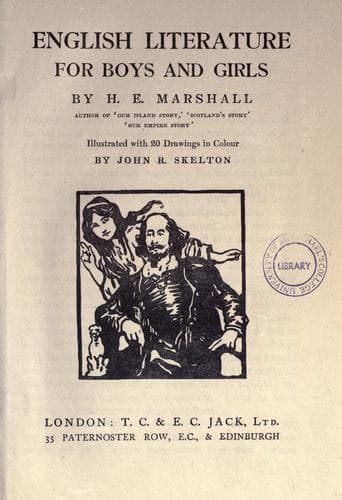
English Literature for Boys and GirlsMarshall, H. E. (Henrietta Elizabeth)
History
English Literature for Boys and Girls
Marshall, H. E. (Henrietta Elizabeth)
English literature -- History and criticism
Finding that Robinson Crusoe was such a success, Defoe began to
write other stories. He wrote of thieves, pirates and rogues.
These stories have the same show of truth as Robinson Crusoe.
Defoe, no doubt, got the ideas for them from the stories of the
rogues with whom he mixed in prison. But they have nearly all
been forgotten, for although they are clever the heroes and
heroines are coarse and the story of their adventures is
unpleasant reading. Yet as history, showing us the state of the
people in the days of Queen Anne and of George I, they are
useful.
Defoe was now well off. He had built himself a handsome house
surrounded by a pleasant garden. He had carriages and horses and
lived in good style with his wife and beautiful daughters. There
seemed to be no reason why he should not live happily and at ease
for the rest of his life. But suddenly one day, for some unknown
reason, he fled from his comfortable home into hiding. Why he
did this no one can tell. For two years he lived a homeless,
skulking fugitive. Then in 1731 he died, if not in poverty at
least in loneliness and distress of mind.
BOOKS TO READ
Robinson Crusoe, abridged by John Lang. Robinson Crusoe, retold
by Edith Robarts, illustrated by J. Hassall, R. I. Robinson
Crusoe (Everyman's Library).
Chapter LXIII SWIFT--THE "JOURNAL TO STELLA"
WE all know what it is to feel hurt and angry, to feel that we
are misunderstood, that no one loves us. At such times it may be
we want to hurt ourselves so that in some mysterious way we may
hurt those who do not love us. We long to die so that they may
be sorry. But these feelings do not come often and they soon
pass. We cry ourselves to sleep perhaps and wake up to find the
evil thoughts are gone. We forget all about them, or if we
remember them we remember to smile at our own foolishness, for we
know that after all we are understood, we are loved. And when we
grow old enough to look back upon those times, although we may
remember the pain of them, we can see that sometimes they came
from our own fault, it was not that we were misunderstood so much
as that we were misunderstanding. Yet whether it be our own
fault or not, when such times do come, the world seems very dark
and life seems full of pain. Then think of what a whole life
filled with these evil thoughts must be. Think of a whole life
made terrible with bitter feelings. That would be misery indeed.
Public-domain text, read in full here on John Shaqi.
Reviews
Reviews
No reviews yet
Be the first to share your thoughts on this work.
Elsewhere in the archive
Join the Discussion
Join the discussion
Sign in to leave a comment or review.
Sign InorCreate an account