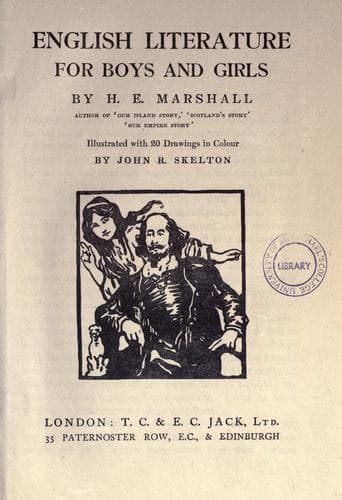
English Literature for Boys and GirlsMarshall, H. E. (Henrietta Elizabeth)
History
English Literature for Boys and Girls
Marshall, H. E. (Henrietta Elizabeth)
English literature -- History and criticism
Jonathan's nurse was also an Englishwoman, and when he was about
a year old she was called home to England to a dying friend. She
saw that she must go to her friend, but she loved her baby-charge
so much that she could not bear to part from him. He had been a
sickly child, often ill, but that seemed only to make him dearer
to her. She held him in her arms thinking how empty they would
fell without their dear burden. She kissed him, jealous at the
thought that he might learn to know and love another nurse, and
she felt that she could not part with him. Making up her mind
that she would not, she wrapped him up warmly and slipped quietly
from the house carrying the baby in her arms. She then ran
quickly to the boat, crept on board, and was well out on the
Irish Sea before it was discovered that she had stolen little
Jonathan from his mother. Mrs. Swift was poor, Jonathan was not
strong so the fond and daring nurse was allowed by the mother to
keep her little charge until he was nearly four. Thus for three
years little Jonathan lived with his nurse at Whitehaven, growing
strong and brown in the sea air. She looked after him lovingly,
and besides feeding and clothing him, taught him so well that
Swift tells us himself, though it seems a little hard to believe,
that he could spell and could read any chapter in the Bible
before he was three.
After Jonathan's return to Ireland his uncle, Godwin Swift, seems
to have taken charge of him, and when he was six to have sent him
to a good school. His mother, meanwhile, went home to her own
people in England, and although mother and son loved each other
they were little together all through life. At fourteen Godwin
Swift sent his nephew from school to Trinity College, Dublin.
But Swift was by this time old enough to know that he was living
on the charity of his uncle and the knowledge was bitter to his
proud spirit. Instead of spurring him on the knowledge weighed
him down. He became gloomy, idle, and wild. He afterwards said
he was a dunce at college and "was stopped of his degree for
dulness and insufficiency." But although at first the examiners
refused to pass him, he was later, for some reason, given a
special degree, granted by favor rather than gained by desert "in
a manner little to his credit," says bitter Swift. Jonathan gave
his uncle neither love nor thanks for his schooling. "He gave me
the education of a dog," was how he spoke of it years after. Yet
he had been sent to the best school in Ireland and to college
later. But perhaps it was not so much the gift as the manner of
giving which Swift scorned. We cannot tell.
Public-domain text, read in full here on John Shaqi.
Reviews
Reviews
No reviews yet
Be the first to share your thoughts on this work.
Elsewhere in the archive
Join the Discussion
Join the discussion
Sign in to leave a comment or review.
Sign InorCreate an account