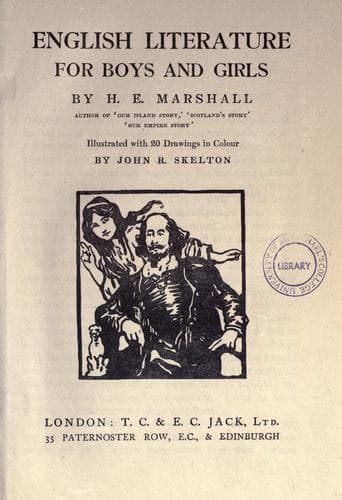
English Literature for Boys and GirlsMarshall, H. E. (Henrietta Elizabeth)
History
English Literature for Boys and Girls
Marshall, H. E. (Henrietta Elizabeth)
English literature -- History and criticism
Soon after Jonathan left college he went to live in the house of
Sir William Temple. Temple was a great man in his day. He had
been an Ambassador, the friend of kings and princes, and he
considered himself something of a scholar. To him Swift acted as
a kind of secretary. To a proud man the post of secretary or
chaplain in a great house was, in those days, no happy one. It
was a position something between that of a servant and a friend,
and in it Swift's haughty soul suffered torments. Sir William,
no doubt, meant to be kind, but he was cold and condescending,
and not a little pompous and conceited. Swift's fierce pride was
ready to fancy insults where none were meant, he resented being
"treated like a schoolboy," and during the years he passed in Sir
William's house he gathered a store of bitterness against the
world in his heart.
But in spite of all his miseries real or imaginary, Swift had at
least one pleasure. Among the many people making up the great
household there was a little girl of seven named Esther Johnson.
She was a delicate little girl with large eyes and black hair.
She and Swift soon grew to be friends, and he spent his happiest
hours teaching her to read and write. It is pleasant to think of
the gloomy, untrained genius throwing off his gloom and bending
all his talents to the task of teaching and amusing this little
delicate child of seven.
With intervals between, Swift remained in Sir William's household
for about five years. Here he began to write poetry, but when he
showed his poems to Dryden, who was a distant kinsman, he got
little encouragement. "Cousin Swift," said the great man, "you
will never be a poet." Here was another blow from a hostile
world which Swift could never either forget or forgive.
As the years went on Swift found his position grow more and more
irksome. At last he began to think of entering the Church as a
means of earning an independent livelihood and becoming his own
master. And one day, having a quarrel with Sir William, he left
his house in a passion and went back to Ireland. Here after some
trouble he was made a priest and received a little seaside parish
worth about a hundred pounds a year.
Swift was now his own master, but he found it dull. He had so
few parishioners that it is said he used to go down to the
seashore and skiff stones in order to gather a congregation. For
he thought if the people would not come to hear sermons they
would come at least to stare at the mad clergyman, and for years
he was remembered as the "mad clergyman." And now because he
found his freedom dull, and for various other reasons, when Sir
William asked him to come back he gladly came. This time he was
much happier as a member of Sir William's household than he had
been before.
Public-domain text, read in full here on John Shaqi.
Reviews
Reviews
No reviews yet
Be the first to share your thoughts on this work.
Elsewhere in the archive
Join the Discussion
Join the discussion
Sign in to leave a comment or review.
Sign InorCreate an account