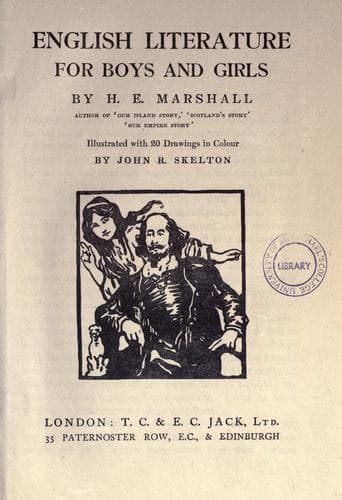
English Literature for Boys and GirlsMarshall, H. E. (Henrietta Elizabeth)
History
English Literature for Boys and Girls
Marshall, H. E. (Henrietta Elizabeth)
English literature -- History and criticism
"And in another isle are men that have flat faces without nose
and without eyes, but they have two small round holes instead of
eyes and they have a flat mouth without lips. . . .
"And in another isle are men that have the lips about their mouth
so great that when they sleep in the sun they cover all their
face with the lip."
But I must not tell all the "lying wonders of our English
knight."* for you must read the book for yourselves. And when
you do you will find that it is written with such an easy air of
truth that you will half believe in Sir John's marvels. Every
now and again, too, he puts in a bit of real information which
helps to make his marvels seem true, so that sometimes we cannot
be sure what is truth and what is fable.
*Colonel Sir Henry Yule, The Book of Sir Marco Polo.
Sir John wandered far and long, but at last his journeyings
ended. "I have passed through many lands and isles and
countries," he says, "and now am come to rest against my will."
And so to find comfort in his "wretched rest" he wrote his book.
"But," he says, "there are many other divers countries, and many
other marvels beyond that I have not seen. Also in countries
where I have been there are many marvels that I speak not of, for
it were too long a tale." And also, he thought, it was as well
to leave something untold "so that other men that go thither may
find enough for to say that I have not told," which was very kind
of him.
Sir John tells us then how he took his book to the holy father
the Pope, and how he caused it to be read, and "the Pope hath
ratified and affirmed my book in all points. And I pray to all
those that read this book, that they will pray for me, and I
shall pray for them."
BOOKS TO READ
The Voyages and Travels of Sir John Mandeville, edited
Chapter XXVI BARBOUR--"THE BRUCE," THE BEGINNINGS OF A
STRUGGLE
WHILE Chaucer was making for us pictures of English life, in the
sister kingdom across the rugged Cheviots another poet was
singing to a ruder people. This poet was John Barbour,
Archdeacon of Aberdeen. An older man than Chaucer, born perhaps
twenty years before the English poet, he died only five years
earlier. So that for many years these two lived and wrote at the
same time.
But the book by which Barbour is remembered best is very
different from that by which we remember Chaucer. Barbour's
best-known book is called The Bruce, and in it, instead of the
quiet tales of middle-class people, we hear throughout the clash
and clang of battle. Here once again we have the hero of
romance. Here once again history and story are mingled, and
Robert the Bruce swings his battle-ax and wings his faultless
arrow, saving his people from the English yoke.
Public-domain text, read in full here on John Shaqi.
Reviews
Reviews
No reviews yet
Be the first to share your thoughts on this work.
Elsewhere in the archive
Join the Discussion
Join the discussion
Sign in to leave a comment or review.
Sign InorCreate an account