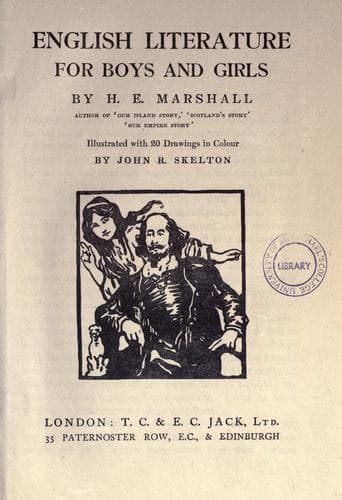
English Literature for Boys and GirlsMarshall, H. E. (Henrietta Elizabeth)
History
English Literature for Boys and Girls
Marshall, H. E. (Henrietta Elizabeth)
English literature -- History and criticism
The music of The Bruce cannot compare with the music of the
Tales, but the spirit throughout is one of manliness, of delight
in noble deeds and noble thoughts. Barbour's way of telling his
stories is simple and straightforward. It is full of stern
battle, yet there are lines of tender beauty, but nowhere do we
find anything like the quiet laughter and humor of Chaucer. And
that is not wonderful, for those were stern times in Scotland,
and The Bruce is as much an outcome of those times as were the
Tales or Piers Ploughman an outcome of the times in England.
But if to Chaucer belongs the title of "Father of English
Poetry," to Barbour belongs that of "Father of Scottish Poetry
and Scottish History." He, indeed, calls the language he wrote
in "Inglis," but it is a different English from that of Chaucer.
They were both founded on Anglo-Saxon, but instead of growing
into modern English, Barbour's tongue grew into what was known
later as "braid Scots." All the quotations that I am going to
give you from the poem I have turned into modern English, for,
although they lose a great deal in beauty, it makes them easier
for every one to understand. For even to the Scots boys and
girls who read this book there are many words in the original
that would need translating, although they are words still used
by every one who speaks Scots to this day. In one page of
twenty-seven lines taken at random we find sixteen such words.
They are, micht, nicht, lickt, weel, gane, ane, nane, stane,
rowit, mirk, nocht, brocht, mair, sperit at, sair, hert. For
those who are Scots it is interesting to know how little the
language of the people has changed in five hundred years.
As of many another of our early poets, we know little of
Barbour's life. He was Archdeacon of Aberdeen, as already said,
and in 1357 he received a safe-conduct from Edward III to allow
him to travel to Oxford with three companions. In those days
there was not as yet any university in Scotland. The monasteries
still held their place as centers of learning. But already the
fame of Oxford had reached the northern kingdom, and Barbour was
anxious to share in the treasures of learning to be found there.
At the moment there was peace between the two countries, but hate
was not dead, it only slumbered. So a safe-conduct or passport
was necessary for any Scotsman who would travel through England
in safety. "Edward the King unto his lieges greeting," it ran.
"Know ye that we have taken under our protection (at the request
of David de Bruce) John Barbour, Archdeacon of Aberdeen, with the
scholars in his company, in coming into our kingdom of England,
in order to study in the university of Oxford, and perform his
scholastic exercises, and in remaining there and in returning to
his own country of Scotland. And we hereby grant him our safe-
conduct, which is to continue in force for one year."
Public-domain text, read in full here on John Shaqi.
Reviews
Reviews
No reviews yet
Be the first to share your thoughts on this work.
Elsewhere in the archive
Join the Discussion
Join the discussion
Sign in to leave a comment or review.
Sign InorCreate an account