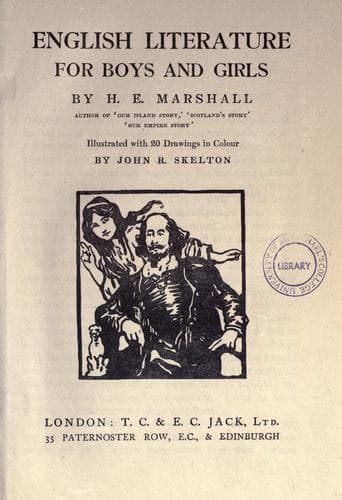
English Literature for Boys and GirlsMarshall, H. E. (Henrietta Elizabeth)
History
English Literature for Boys and Girls
Marshall, H. E. (Henrietta Elizabeth)
English literature -- History and criticism
Barbour was given two other safe-conducts, one to allow him again
to visit Oxford, and another to allow him to pass through England
on his way to France. Besides this, we know that Barbour
received a pension from the King of Scotland, and that he held
his archdeaconry until his death; and that is almost all that we
know certainly of his life.
The Bruce is the great national poem, Robert the Bruce the great
national hero of Scotland. But although The Bruce concerns
Scotland in the first place, it is of interest to every one, for
it is full of thrilling stories of knightly deeds, many of which
are true. "The fine poem deserves to be better known," says one
of its editors.* "It is a proud thing for a country to have
given a subject for such an Odyssey, and to have had so early in
its literature a poet worthy to celebrate it." And it is little
wonder that Barbour wrote so stirringly of his hero, for he lived
not many years after the events took place, and when he was a
schoolboy Robert the Bruce was still reigning over Scotland.
*Cosmo Innes.
In the beginning of his book Barbour says:--
"Stories to read are delightful,
Supposing even they be naught but fable;
Then should stories that true were,
And that were said in good manner,
Have double pleasantness in hearing.
The first pleasantness is the telling
And the other is the truthfulness
That shows the thing right as it was.
And such things that are likand
To man's hearing are pleasant;
Therefore I would fain set my will,
If my wit may suffice thereto,
To put in writ a truthful story,
That it last aye forth in memory,
So that no time of length it let,
Nor gar it wholly be forgot."
So he will, he says, tell the tale of "stalwart folk that lived
erst while," of "King Robert of Scotland that hardy was of heart
and hand," and of "Sir James of Douglas that in his time so
worthy was," that his fame reached into far lands. Then he ends
this preface with a prayer that God will give him grace, "so that
I say naught but soothfast thing."
The story begins with describing the state of Scotland after the
death of Alexander III, when Edward I ruled in England.
Alexander had been a good king, but at his death the heir to the
throne was a little girl, the Maid of Norway. She was not even
in Scotland, but was far across the sea. And as this child-queen
came sailing to her kingdom she died on board ship, and so never
saw the land over which she ruled.
Then came a sad time for Scotland. "The land six year and more
i-faith lay desolate," for there was no other near heir to the
throne, and thirteen nobles claimed it. At last, as they could
not agree which had the best right, they asked King Edward of
England to decide for them.
Public-domain text, read in full here on John Shaqi.
Reviews
Reviews
No reviews yet
Be the first to share your thoughts on this work.
Elsewhere in the archive
Join the Discussion
Join the discussion
Sign in to leave a comment or review.
Sign InorCreate an account