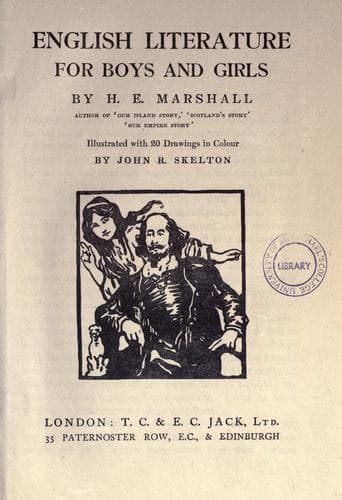
English Literature for Boys and GirlsMarshall, H. E. (Henrietta Elizabeth)
History
English Literature for Boys and Girls
Marshall, H. E. (Henrietta Elizabeth)
English literature -- History and criticism
Barbour was born about six years after the battle of Bannockburn.
As a boy he must have heard many stories of these stirring times
from those who had taken part in them. He must have known many a
woman who had lost husband or father in the great struggle. He
may even have met King Robert himself. And as a boy he must have
shared in the sorrow that fell upon the land when its hero died.
He must have remembered, when he grew up, how the people mourned
when the dead body of the Douglas and the heart of the gallant
Bruce were brought home from Spain. But in spite of Barbour's
prayer to be kept from saying "ought but soothfast thing," we
must not take The Bruce too seriously. If King Robert was a true
King he was also a true hero of romance. We must not take all
The Bruce as serious history, but while allowing for the truth of
much, we must also allow something for the poet's worship of his
hero, a hero, too, who lived so near the time in which he wrote.
We must allow something for the feelings of a poet who so
passionately loved the freedom for which that hero fought.
BOOKS TO READ
There is, so far as I know, no modernized version of The Bruce,
but there are many books illustrative of the text. In this
connection may be read Robert the Bruce (Children's heroes
Series), by Jeannie Lang; Chapters XXIV to XLIV. Scotland's
Story, by H. E. Marshall; The Lord of the Isles, by Sir Walter
Scott; Castle Dangerous, by Sir Walter Scott; "The Heart of the
Bruce" in Lays of the Scottish Cavaliers, by Aytoun. The most
available version of The Bruce in old "Inglis," edited by W. M.
Mackenzie.
Chapter XXVIII A POET KING
The Bruce is a book which is the outcome of the history of the
times. It is the outcome of the quarrels between England and
Scotland, and of Scotland's struggle for freedom. Now we come to
another poet, and another poem which was the outcome of the
quarrels between England and Scotland. For although Scotland's
freedom was never again in danger, the quarrels between the two
countries were, unhappily, not over.
In 1399, as we know, Henry IV wrested the crown of England from
Richard II. The new King proved no friend to Scotland, for he
desired, as those before him had desired, to rule both countries.
Henry lost no chance, therefore, by which he might gain his end.
So when in 1405 the King of Scotland sent his little son James to
be educated in France, the English attacked the ship in which he
sailed and took him prisoner. Instead, then, of going as a guest
to the court of France, the Prince was carried as a prisoner to
the court of England. When the old King heard the sad news he
died, and James, captive though he was, became King of Scotland.
Public-domain text, read in full here on John Shaqi.
Reviews
Reviews
No reviews yet
Be the first to share your thoughts on this work.
Elsewhere in the archive
Join the Discussion
Join the discussion
Sign in to leave a comment or review.
Sign InorCreate an account