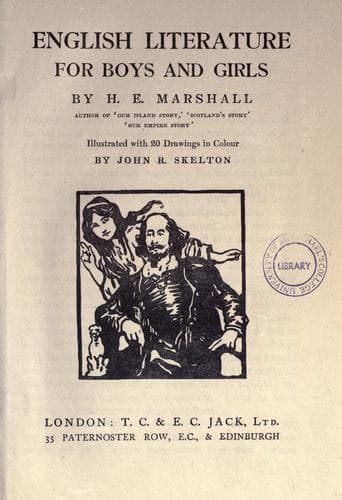
English Literature for Boys and GirlsMarshall, H. E. (Henrietta Elizabeth)
History
English Literature for Boys and Girls
Marshall, H. E. (Henrietta Elizabeth)
English literature -- History and criticism
Those were again troublous times in Scotland. The captive King's
uncle was chosen as Regent to rule in his absence. But he,
wishing to rule himself, had no desire that his nephew should be
set free. So through the reigns of Henry IV and of Henry V James
remained a prisoner. But although a prisoner he was not harshly
treated, and the Kings of England took care that he should
receive an education worthy of a prince. James was taught to
read and write English, French, and Latin. He was taught to
fence and wrestle, and indeed to do everything as a knight
should. Prince James was a willing pupil; he loved his books,
and looked forward to the coming of his teachers, who lightened
the loneliness of his prison.
"But," says a Frenchman who has written a beautiful little book
about this captive King, "'stone walls do not a prison make, nor
iron bars a cage': the soul of the child, who grew to be a youth,
was never a prisoner. Behind the thick walls of the Tower, built
long ago by the Conqueror, he studied. Guards watched over him,
but his spirit was far away voyaging in the realms of poetry.
And in these thought journeys, sitting at his little window, with
a big book upon his knee, he visited the famous places which the
Gesta Romanorum unrolled before him. . . . The 'noble senator'
Boece taught him resignation. William de Lorris took him by the
hand and led him to the garden of the Rose. The illustrious
Chaucer invited him to follow the gay troop of pilgrims along the
highroad to Canterbury. The grave Gower, announcing in advance a
sermon of several hours, begged him to be seated, and to the
murmur of his wise talk, his head leaning on the window frame,
the child slept peacefully.
"Thus passed the years, and the chief change that they brought
was a change of prison. After the Tower it was the Castle of
Nottingham, another citadel of the Norman time, then Evesham,
then again the Tower when Henry V came to the throne; and at
last, and this was by contrast almost liberty, the Castle of
Windsor."*
Public-domain text, read in full here on John Shaqi.
Reviews
Reviews
No reviews yet
Be the first to share your thoughts on this work.
Elsewhere in the archive
Join the Discussion
Join the discussion
Sign in to leave a comment or review.
Sign InorCreate an account