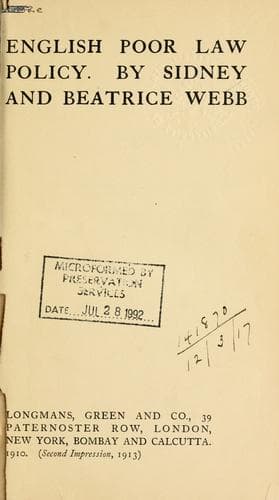
Great Britain. Royal Commission on Poor Laws and Relief of Distress; Poor -- Great Britain; Poor laws -- Great Britain
idiots, and mentally defectives, the workhouse had, without suitable
provision for them, and often to the unspeakable discomfort of the other
inmates, become a permanent home.
[418] There had apparently been a doubt as to whether a husband
was legally bound to contribute towards the maintenance of a wife
who had been removed under legal authority to a lunatic asylum. In
1850 the Central Authority got an Act passed to require him to pay
(13 and 14 Vic. c. 101, sec. 4) on the ground that "great hardship
has been frequently occasioned to parishes, who have been
burthened with the heavy expense of such maintenance without the
means of recovering from the husband even a partial reimbursement"
(Third Annual Report, 1850, p. 16).
[419] Special Orders of 18th June 1867, 6th October 1870, 23rd
December 1870, 17th June 1871, etc. It may be noted that in 1862
the Guardians of St. George's, Southwark, provided a separate
establishment at Mitcham for their idiotic and imbecile paupers,
which was regulated by Special Order of 30th April 1862.
[420] On 1st January 1852, the number in the county or borough
asylums was 9412, and in licensed houses 2584; making a total of
11,996 out of 21,158 paupers of unsound mind (Fifth Annual Report,
1852, p. 152). On 1st January 1870, the number in asylums had
risen to 26,634, and that in licensed houses had fallen to 1589,
making a total of 28,223 out of 46,548 paupers of unsound mind
(Twenty-third Annual Report, 1870-71, p. xxiii).
_G._--_Defectives_
During this period, the blind, the deaf and dumb, and the lame and
deformed were increasingly recognised by Parliament as classes for whom
the Poor Law authorities might, if they chose, provide expensive
treatment. This was done by authorising boards of guardians, if they
chose, to pay for their maintenance, whether children or adults, in
special institutions.[421] We do not find that the Central Authority
suggested the adoption of this or any other policy or gave any lead to
the boards of guardians with regard to these cases.[422]
[421] 25 & 26 Vic. c. 43, sec. 10 (Poor Law Certified Schools Act
of 1862); 30 & 31 Vic. c. 106, sec. 21 (1867); 31 & 32 Vic. c.
122, sec. 42 (1868).
[422] In 1849 the expenses of conveying a blind pauper to hospital
were allowed to be paid under the head of non-resident relief in
case of sickness (_Official Circular_, No. 24, N.S., April 1849,
p. 64).
_H._--_The Aged and Infirm_
Public-domain text, read in full here on John Shaqi.
Reviews
Reviews
No reviews yet
Be the first to share your thoughts on this work.
Elsewhere in the archive
Join the Discussion
Join the discussion
Sign in to leave a comment or review.
Sign InorCreate an account