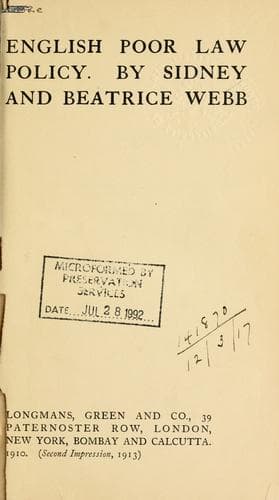
Great Britain. Royal Commission on Poor Laws and Relief of Distress; Poor -- Great Britain; Poor laws -- Great Britain
The able, zealous, and somewhat doctrinaire inspectorate, especially
between 1871 and 1885, stands always on the "principles of 1834" in
their strictest interpretation--constantly using language, indeed, which
went beyond any proposals of the 1834 Report, or any policy embodied in
the documents of the Central Authority of 1834-47. On the other hand,
the president (and Parliament with his concurrence) sporadically brought
in (especially after 1885) a note that some might term a sentimental,
others an enlightened humanitarianism, with regard to particular
sections--the unemployed, the decayed members of friendly societies, the
"deserving aged poor" generally. This humanitarianism was certainly in
direct contradiction of the "principles of 1834." How far it may be said
to have embodied, perhaps unconsciously, other principles will
subsequently appear.
The cleavage in policy between the inspectorate and the president did
not at first manifest itself. For the first decade or so, the successive
presidents and the inspectorate seem to be at one in a policy of "strict
administration"--a policy as to which we cannot discover whether it was
due to the influence of such presidents as Mr. Goschen and Mr. Stansfeld
upon such inspectors as Mr. Corbett, Mr. Doyle, Mr. Wodehouse, and Mr.
Longley, or _vice versa_. We may perhaps ascribe to the caution of the
secretariat the confining of this policy to the general terms of
circulars and minutes, thus avoiding alike the necessary precision of
orders and statutes and any explicit extension of the "principles of
1834" to classes other than the able-bodied.
Public-domain text, read in full here on John Shaqi.
Reviews
Reviews
No reviews yet
Be the first to share your thoughts on this work.
Elsewhere in the archive
Join the Discussion
Join the discussion
Sign in to leave a comment or review.
Sign InorCreate an account