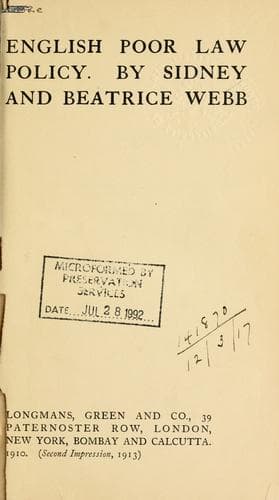
Great Britain. Royal Commission on Poor Laws and Relief of Distress; Poor -- Great Britain; Poor laws -- Great Britain
We have to note, in the first place, that the Majority Report lays the
utmost stress on the importance of retaining in each locality what is
definitely a "Destitution Authority." "It should," they declare, "be a
fundamental condition of the assistance system of the future that the
responsibility for the due and effective relief of all necessitous
persons at the public expense should be in the hands of one, and only
one, authority in each County and County Borough."[847] To this
principle they recur again and again as of paramount importance. In
retaining this General Destitution Authority, and in emphasising the
necessity for the treatment of all sections--the infants, the children,
the sick, the aged, the prematurely incapacitated, the able-bodied
unemployed--being committed to its charge, the Majority Report may
fairly claim to be standing on the same ground as the authors of the
1834 Report, though with a significant difference. To the Royal
Commission of 1834 the single all-embracing Destitution Authority was
not a matter of principle at all, but a necessity, which no one
questioned. Throughout the whole country there had been only one kind of
Local Authority which gave any sort of public assistance to the poor,
and that was the Poor Law Authority. The 1834 Report could, accordingly,
take it for granted that all sections of the persons to be relieved at
the public expense on the ground of their necessities must be dealt
with, as destitute persons, by one and the same authority. In 1909 the
position has become quite different. There have grown up, since 1834,
other public authorities in each district, which provide, independently
of the Poor Law, this or that form of public assistance to persons who
require it, sometimes to all who apply, sometimes to those only who
prove their need. The Local Education Authorities, the Local Health
Authorities, the Local Lunacy Authorities, the Local Pension
Authorities, and the Local Unemployed Authorities are, in fact, spending
in the aggregate on the children, the sick, the mentally defective, the
aged and the able-bodied unemployed, in their several forms of public
assistance, out of the same fund of rates and taxes, _more than twice as
much every year as all the Poor Law Authorities put together_. To the
Royal Commission of 1909 the retention of a general Destitution
Authority, dealing with all sections of destitute persons as destitute
persons, was, therefore, not a necessity. It was a deliberate choice,
and we find them erecting it into a principle. This principle does not,
as might perhaps be supposed, apply only to the provision of
maintenance. It is expressly asserted that the schooling and industrial
training of the persons relieved and the medical attendance of the sick,
so far as it is provided at the public expense, must equally form part
of the work of the new Poor Law Authorities. Even the provision of Day
Industrial Schools for destitute uncared-for children, of public
Public-domain text, read in full here on John Shaqi.
Reviews
Reviews
No reviews yet
Be the first to share your thoughts on this work.
Elsewhere in the archive
Join the Discussion
Join the discussion
Sign in to leave a comment or review.
Sign InorCreate an account