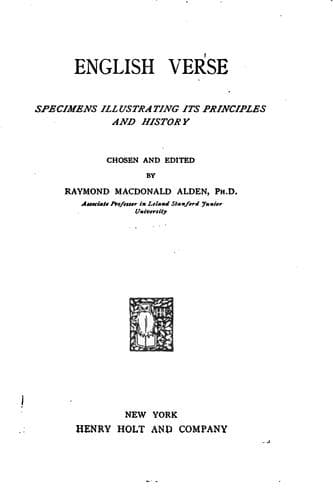
English Verse: Specimens Illustrating its Principles and HistoryAlden, Raymond MacDonald
General
English Verse: Specimens Illustrating its Principles and History
Alden, Raymond MacDonald
English language -- Versification; English poetry
With Chaucer we have the first deliberate use of the five-stress
couplet, in continuous verse, known to English poetry. His earliest use
of the pentameter line was in the _Compleynt to Pitee_ (perhaps written
about 1371), in the "rime royal" stanza; his earliest use of the
pentameter couplet was in the _Legend of Good Women_, usually dated
1385. From that time the measure became almost his only instrument, and
we find altogether in his poetry some 16,000 lines in the couplet,
besides some 14,000 more in rime royal. Too much praise cannot be given
Chaucer's use of the couplet. Although it was an experiment in English
verse, it has perhaps hardly been used since his time with greater
skill. He used a variety of cesuras (see ten Brink's monograph for the
enumeration of them), a very large number of feminine endings (such as
the still pronounced final-_e_ and similar syllables easily provided),
free inversions in the first foot and elsewhere, and many run-on lines
(in a typical 100 lines some 16 run-on lines and 7 run-on couplets
appearing). The total effect is one of combined freedom and mastery, of
fluent conversational style yet within the limits of guarded artistic
form. "Much more regularly than the French and Provençals, and yet
without pedantic stiffness, he made his verse advance with a sort of
iambic gait, and he was therefore able to give up and exchange for a
freer arrangement the immovable cesura, which these poets had always
made to coincide with a foot-ending." (Ten Brink, in _English
Literature_, Kennedy trans., vol. ii. p. 48.) On Chaucer's verse, see,
besides the monograph of ten Brink already cited, Lounsbury's _Studies
in Chaucer_, vol. iii. pp. 297 ff., and Schipper, vol. i. pp. 442 ff.
Public-domain text, read in full here on John Shaqi.
Reviews
Reviews
No reviews yet
Be the first to share your thoughts on this work.
Elsewhere in the archive
Join the Discussion
Join the discussion
Sign in to leave a comment or review.
Sign InorCreate an account