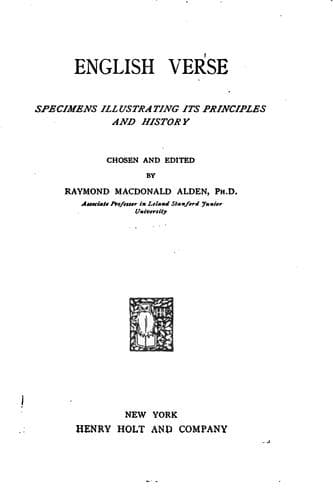
English Verse: Specimens Illustrating its Principles and HistoryAlden, Raymond MacDonald
General
English Verse: Specimens Illustrating its Principles and History
Alden, Raymond MacDonald
English language -- Versification; English poetry
Spenser's use of the heroic couplet for the _Mother Hubbard's Tale_ is
the earliest instance of its adoption in English for satirical verse,--a
purpose for which its later history showed it to be peculiarly well
fitted.
Upon her head she wore a myrtle wreath,
From whence her veil reach'd to the ground beneath:
Her veil was artificial flowers and leaves,
Whose workmanship both man and beast deceives:
Many would praise the sweet smell as she past,
When 'twas the odor which her breath forth cast;
And there for honey bees have sought in vain,
And, beat from thence, have lighted there again.
About her neck hung chains of pebble-stone,
Which, lighten'd by her neck, like diamonds shone.
(MARLOWE: _Hero and Leander_, ll. 17-26. ab. 1590, pub. 1598.)
Too popular is tragic poesy,
Straining his tip-toes for a farthing fee,
And doth beside on rimeless numbers tread;
Unbid iambics flow from careless head.
Some braver brain in high heroic rhymes
Compileth worm-eat stories of old times:
And he, like some imperious Maronist,
Conjures the Muses that they him assist.
Then strives he to bombast his feeble lines
With far-fetch'd phrase.-- ...
Painters and poets, hold your ancient right:
Write what you will, and write not what you might:
Their limits be their list, their reason will.
But if some painter in presuming skill
Should paint the stars in centre of the earth,
Could ye forbear some smiles, and taunting mirth?
(JOSEPH HALL: _Virgidemiarum Libri VI._, bk. i. satire 4. 1597.)
Joseph Hall was the most vigorous satirist of the group of Elizabethans
who, in the last decade of the sixteenth century, were imitating the
satires of Horace, Juvenal, and Persius. Hall's satires have a curiously
eighteenth-century flavor, and his couplets are frequently very similar
to those of the age of Pope. Thus Thomas Warton (in his _History of
English Poetry_) observed of Hall that "the fabric of the couplets
approaches to the modern standard;" and Anderson, who edited the
_British Poets_ in 1795, said: "Many of his lines would do honor to the
most harmonious of our modern poets. The sense has generally such a
pause, and will admit of such a punctuation at the close of the second
line, as if it were calculated for a modern ear." On the verse of these
Elizabethan satirists in general, see _The Rise of Formal Satire in
England_, by the present editor (_Publications of the Univ. of Penna_.).
Public-domain text, read in full here on John Shaqi.
Reviews
Reviews
No reviews yet
Be the first to share your thoughts on this work.
Elsewhere in the archive
Join the Discussion
Join the discussion
Sign in to leave a comment or review.
Sign InorCreate an account