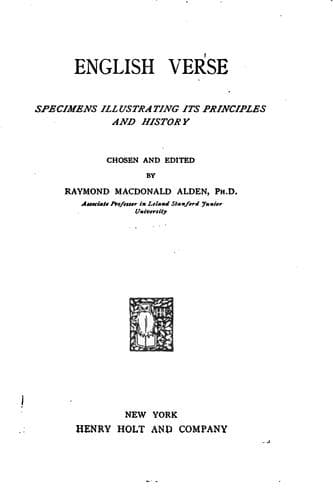
English Verse: Specimens Illustrating its Principles and HistoryAlden, Raymond MacDonald
General
English Verse: Specimens Illustrating its Principles and History
Alden, Raymond MacDonald
English language -- Versification; English poetry
Is not thilke the mery moneth of May,
When love-lads masken in fresh aray?
How falles it, then, we no merrier bene,
Ylike as others, girt in gawdy greene?
Our bloncket liveryes bene all to sadde
For thilke same season, when all is ycladd
With pleasaunce: the grownd with grasse, the Woods
With greene leaves, the bushes with bloosming buds.
... Tho to the greene Wood they speeden hem all,
To fetchen home May with their musicall:
And home they bringen in a royall throne,
Crowned as king: and his Queene attone
Was Lady Flora, on whom did attend
A fayre flocke of Faeries, and a fresh bend
Of lovely Nymphs. (O that I were there,
To helpen the Ladyes their Maybush beare!)
Ah! Piers, bene not thy teeth on edge, to thinke
(SPENSER: _The Shepherd's Calendar, May_. 1579.)
This specimen is properly not in five-stress verse, but in irregular
four-stress ("tumbling verse"); compare the specimen on p. 158, above.
We have a close approach, however, to the regular five-stress verse, in
such lines as the fourth, fifth, eleventh, thirteenth, and seventeenth.
On this and similar passages in the _Shepherd's Calendar_, as
illustrating the close relation between the native measure and the newer
one, see an article by Professor Gummere, in the _American Journal of
Philology_, vol. vii. pp. 53ff. Other verses cited by Dr. Gummere are:
"Whose way is wildernesse, whose ynne Penaunce."
"And dirks the beauty of my blossomes rownd."
"That oft the blood springeth from woundes wyde."
"There at the dore he cast me downe hys pack."
It is pointed out that the regular five-stress line, when having--as
very frequently--only four full stresses (two or three light syllables
coming together, especially at the pause), can hardly be distinguished
from certain forms of the native four-stress verse. See also the
Eclogues for February and August, in the _Shepherd's Calendar_. Dr.
Gummere's conclusion is, that "practically all the elements of
Anglo-Saxon verse are preserved in our modern poetry, though in
different combinations, with changed proportional importance."
But the false Fox most kindly played his part;
For whatsoever mother-wit or art
Could work, he put in proof: no practice sly,
No counterpoint of cunning policy,
No reach, no breach, that might him profit bring,
But he the same did to his purpose wring....
He fed his cubs with fat of all the soil,
And with the sweet of others' sweating toil;
He crammed them with crumbs of benefices,
And fill'd their mouths with meeds of malefices.
... No statute so established might be,
Nor ordinance so needful, but that he
Would violate, though not with violence,
Yet under color of the confidence
The which the Ape repos'd in him alone,
And reckon'd him the kingdom's corner-stone.
(SPENSER: _Mother Hubbard's Tale_, ll. 1137-1166. 1591.)
Public-domain text, read in full here on John Shaqi.
Reviews
Reviews
No reviews yet
Be the first to share your thoughts on this work.
Elsewhere in the archive
Join the Discussion
Join the discussion
Sign in to leave a comment or review.
Sign InorCreate an account