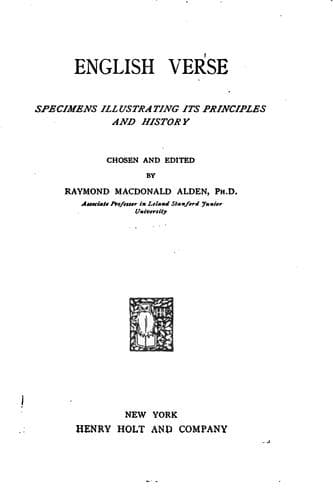
English Verse: Specimens Illustrating its Principles and HistoryAlden, Raymond MacDonald
General
English Verse: Specimens Illustrating its Principles and History
Alden, Raymond MacDonald
English language -- Versification; English poetry
Edmund Waller is the chief representative of the early classical poetry
of the seventeenth century, and of the polishing and regulating of the
couplet which prepared the way for the verse of Dryden and Pope. The
dominant characteristic of this verse is its avoidance of _enjambement_,
or run-on lines, still more of run-on couplets. The growing precision of
French verse at the same time was perhaps influential in England.
Malherbe, who was at the French court after 1605, set rules for more
regular verse, and forbade, among other things, the use of run-on
lines--a precept which held good in French poetry until the nineteenth
century. The influence of Waller in England was, for a considerable
period, hardly less than that of Malherbe in France. Dryden said that
"the excellence and dignity" of rime "were never known till Mr. Waller
taught it; he first made writing easily an art; first showed us to
conclude the sense most commonly in distichs, which, in the verse of
those before him, runs on for so many lines together that the reader is
out of breath to overtake it. This sweetness of Mr. Waller's lyric poesy
was afterward followed, in the epic, by Sir John Denham, in his
_Cooper's Hill_." (Epistle Dedicatory of _The Rival Ladies_.) In another
place Dryden observed that only Waller, in English, had surpassed
Spenser in the harmony of his verse. Dryden's view was later echoed by
Pope, who exhorted his readers to
"praise the easy vigor of a line
Where Denham's strength and Waller's sweetness join."
(_Essay on Criticism_, l. 360.)
Public-domain text, read in full here on John Shaqi.
Reviews
Reviews
No reviews yet
Be the first to share your thoughts on this work.
Elsewhere in the archive
Join the Discussion
Join the discussion
Sign in to leave a comment or review.
Sign InorCreate an account