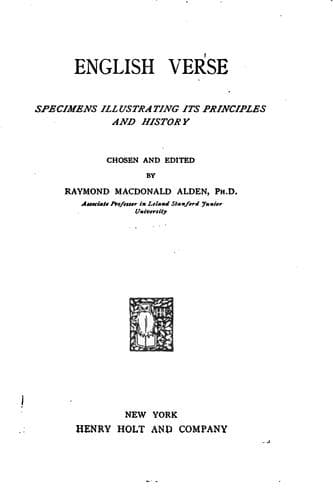
English Verse: Specimens Illustrating its Principles and HistoryAlden, Raymond MacDonald
General
English Verse: Specimens Illustrating its Principles and History
Alden, Raymond MacDonald
English language -- Versification; English poetry
But the most remarkable praise of Waller is found in the Preface to his
posthumous poems, 1690, generally attributed to Bishop Atterbury. "He
was indeed the parent of English verse, and the first that shewed us our
tongue had beauty and numbers in it.... The tongue came into his hands
like a rough diamond; he polished it first, and to that degree that all
artists since him have admired the workmanship, without pretending to
mend it.... He undoubtedly stands first in the list of refiners, and for
aught I know, last, too; for I question whether in Charles the Second's
reign English did not come to its full perfection; and whether it has
not had its Augustan Age, as well as the Latin.... We are no less
beholding to him for the new turn of verse, which he brought in, and the
improvement he made in our numbers. Before his time men rhymed, indeed,
and that was all: as for the harmony of measure, and that dance of words
which good ears are so much pleased with, they knew nothing of it. Their
poetry then was made up almost entirely of monosyllables, which, when
they come together in any cluster, are certainly the most harsh,
untunable things in the world. If any man doubts of this, let him read
ten lines in Donne, and he'll quickly be convinced. Besides, their
verses ran all into one another, and hung together, throughout a whole
copy, like the _hook't atoms_ that compose a body in Des Cartes. There
was no distinction of parts, no regular stops, nothing for the ear to
rest upon. But as soon as the copy began, down it went like a larum,
incessantly; and the reader was sure to be out of breath before he got
to the end of it. So that really verse in those days was but downright
prose, tagged with rhymes. Mr. Waller removed all these faults, brought
in more polysyllables and smoother measures, bound up his thoughts
better and in a cadence more agreeable to the nature of the verse he
wrote in: so that wherever the natural stops of that were, he contrived
the little breakings of his sense so as to fall in with 'em. And for
that reason, since the stress of our verse lies commonly upon the last
syllable, you'll hardly ever find him using a word of no force
there."[21] Waller's editor thus clearly discerns the very
characteristics of his verse which are avoided by the master-poets--the
coincidence of phrase-pauses and verse-pauses, and regularity in the
placing of stress.
Public-domain text, read in full here on John Shaqi.
Reviews
Reviews
No reviews yet
Be the first to share your thoughts on this work.
Elsewhere in the archive
Join the Discussion
Join the discussion
Sign in to leave a comment or review.
Sign InorCreate an account