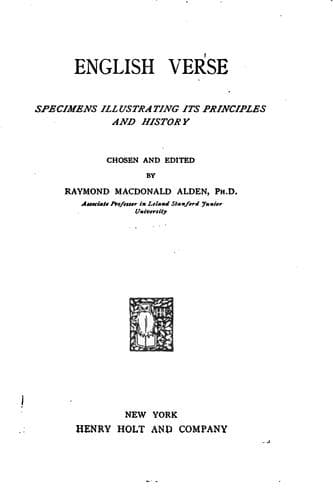
English Verse: Specimens Illustrating its Principles and HistoryAlden, Raymond MacDonald
General
English Verse: Specimens Illustrating its Principles and History
Alden, Raymond MacDonald
English language -- Versification; English poetry
"The heroic couplet," says Mr. Gosse, "was never employed, even by Pope
himself, with more melody than by Goldsmith in this poem." (_Eighteenth
Century Literature_, p. 320.) Its use at this time, when the revival of
blank verse by Thomson and others had seriously affected the prestige of
the couplet, was a sign of Goldsmith's reactionary tendency toward the
school of Pope. His dislike of blank verse he expressed in his early
work on the _Present State of Polite Learning_, saying that it might be
reckoned among "several disagreeable instances of pedantry" lately
proceeding "from a desire in the critic of grafting the spirit of
ancient languages upon the English." (_Works_, Globe ed., p. 439.) This
opinion was of course shared by Goldsmith's friend, Dr. Johnson, whose
two important poems (_London_ and _The Vanity of Human Wishes_) stand
with the two of Goldsmith as the last notable pieces of English poetry
of the classical school. While Johnson admitted that he could not "wish
that Milton had been a rhymer," yet he never lost an opportunity to
speak contemptuously of blank verse as a poetic form, and quoted
approvingly the saying of a critic that it "seems to be verse only to
the eye." (_Life of Milton._)
In front of these came Addison. In him
Humor, in holiday and sightly trim,
Sublimity and Attic taste combined
To polish, furnish, and delight the mind.
Then Pope, as harmony itself exact,
In verse well-disciplined, complete, compact,
Gave virtue and morality a grace
That, quite eclipsing pleasure's painted face,
Levied a tax of wonder and applause,
Even on the fools that trampled on their laws.
But he (his musical finesse was such,
So nice his ear, so delicate his touch)
Made poetry a mere mechanic art,
And every warbler has his tune by heart.
Nature imparting her satiric gift,
Her serious mirth, to Arbuthnot and Swift,
With droll sobriety they raised a smile
At folly's cost, themselves unmoved the while.
That constellation set, the world in vain
Must hope to look upon their like again.
(COWPER: _Table Talk_. 1782.)
Behold! in various throngs the scribbling crew,
For notice eager, pass in long review:
Each spurs his jaded Pegasus apace,
And rhyme and blank maintain an equal race;
Sonnets on sonnets crowd, and ode on ode;
And tales of terror jostle on the road;
Immeasurable measures move along;
For simpering folly loves a varied song,
To strange mysterious dulness still the friend,
Admires the strain she cannot comprehend.
Thus Lays of Minstrels--may they be the last!--
On half-strung harps whine mournful to the blast;
While mountain spirits prate to river sprites,
That dames may listen to the sound at nights;
And goblin brats, of Gilpin Horner's brood,
Decoy young border-nobles through the wood,
And skip at every step, Lord knows how high,
And frighten foolish babes, the Lord knows why.
Public-domain text, read in full here on John Shaqi.
Reviews
Reviews
No reviews yet
Be the first to share your thoughts on this work.
Elsewhere in the archive
Join the Discussion
Join the discussion
Sign in to leave a comment or review.
Sign InorCreate an account