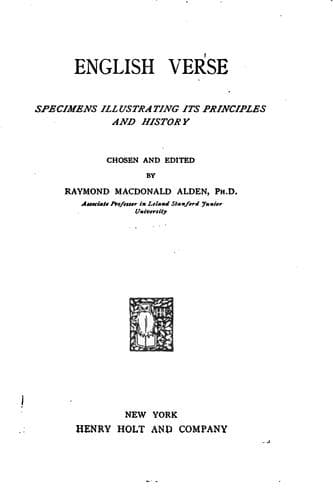
English Verse: Specimens Illustrating its Principles and HistoryAlden, Raymond MacDonald
General
English Verse: Specimens Illustrating its Principles and History
Alden, Raymond MacDonald
English language -- Versification; English poetry
(BYRON: _English Bards and Scotch Reviewers_. 1809.)
View now the winter storm! above, one cloud,
Black and unbroken, all the skies o'ershroud:
The unwieldy porpoise through the day before
Had rolled in view of boding men on shore;
And sometimes hid and sometimes showed his form,
Dark as the cloud and furious as the storm.
All where the eye delights yet dreads to roam,
The breaking billows cast the flying foam
Upon the billows rising--all the deep
Is restless change; the waves so swelled and steep,
Breaking and sinking, and the sunken swells,
Nor one, one moment, in its station dwells....
Darkness begins to reign; the louder wind
Appals the weak and awes the firmer mind;
But frights not him whom evening and the spray
In part conceal--yon prowler on his way.
Lo, he has something seen; he runs apace,
As if he feared companion in the chase;
He sees his prize, and now he turns again,
Slowly and sorrowing--"Was your search in vain?"
Gruffly he answers, "'Tis a sorry sight!
A seaman's body: there'll be more to-night!"
(CRABBE: _The Borough_, letter i. 1810.)
Crabbe's poems are the latest to use the strict Popean couplet for
narrative and descriptive purposes, and his couplets have a certain
characteristic reticence and vigor. Professor Woodberry praises them in
an interesting passage on "the old heroic rhymed couplet, that simplest
form of English verse music, which could rise, nevertheless, to the
almost lyric loftiness of the last lines of the _Dunciad_; so supple and
flexible; made for easy simile and compact metaphor; lending itself so
perfectly to the sudden flash of wit or turn of humor; the natural shell
of an epigram; compelling the poet to practice all the virtues of
brevity; checking the wandering fancy, and repressing the secondary
thought; requiring in a masterly use of it the employment of more mental
powers than any other metrical form; despised and neglected now because
the literature which is embodied in it is despised and neglected, yet
the best metrical form which intelligence, as distinct from poetical
feeling, can employ." (_Makers of Literature_, p. 104.)
The flower-beds all were liberal of delight:
Roses in heaps were there, both red and white,
Lilies angelical, and gorgeous glooms
Of wall-flowers, and blue hyacinths, and blooms
Hanging thick clusters from light boughs; in short,
All the sweet cups to which the bees resort;
With plots of grass, and leafier walks between
Of red geraniums, and of jessamine,
And orange, whose warm leaves so finely suit,
And look as if they shade a golden fruit;
And midst the flowers, turfed round beneath a shade
Of darksome pines, a babbling fountain played,
And 'twixt their shafts you saw the water bright,
Which through the tops glimmered with showering light.
(LEIGH HUNT: _The Story of Rimini_. 1816.)
Public-domain text, read in full here on John Shaqi.
Reviews
Reviews
No reviews yet
Be the first to share your thoughts on this work.
Elsewhere in the archive
Join the Discussion
Join the discussion
Sign in to leave a comment or review.
Sign InorCreate an account