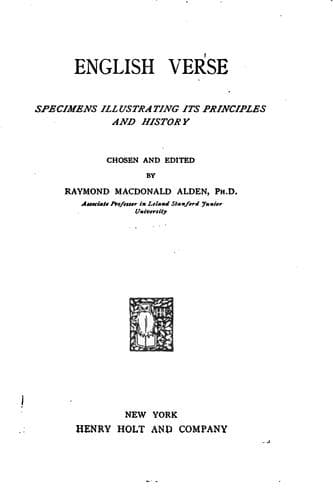
English Verse: Specimens Illustrating its Principles and HistoryAlden, Raymond MacDonald
General
English Verse: Specimens Illustrating its Principles and History
Alden, Raymond MacDonald
English language -- Versification; English poetry
In Milton's own prefatory note to _Paradise Lost_, he called his blank
verse "English heroic verse without rime." Rime he spoke of as "the
invention of a barbarous age, ... graced indeed since by the use of some
famous modern poets,"--not least among them, he might have said, being
John Milton himself. He described also the special character of his
verse in saying that "true musical delight ... consists only in apt
numbers, fit quantity of syllables, and the sense variously drawn out
from one verse into another,"--that is, by _enjambement_. "This neglect
then of rime so little is to be taken for a defect, ... that it rather
is to be esteemed an example set, the first in English, of ancient
liberty recovered to heroic poem from the troublesome and modern bondage
of riming."[32]
It appears from this note that Milton regarded his heroic blank verse as
a different measure from the familiar dramatic blank verse. The latter
he used in _Samson Agonistes_, the verse-structure of which will be seen
to differ from that of _Paradise Lost_; the most salient distinction is
the more frequent use of feminine endings. Mr. Symonds remarks
interestingly on the "difference between Shaksperian and Miltonic,
between dramatic and epical blank verse. The one is simple in
construction and progressive, the other is complex and stationary....
The one exhibits a thought, in the process of formation, developing
itself from the excited fancy of the speaker. The other presents to us
an image crystallized and perfect in the poet's mind; the one is in
time, the other in space--the one is a growing and the other a complete
organism.... The one, if we may play upon a fancy, resembles Music, and
the other Architecture." (_Blank Verse_, p. 58.)
Methinks I do not want
That huge long train of fawning followers,
That swept a furlong after me.
'Tis true I am alone;
So was the godhead, ere he made the world,
And better served himself than served by nature.
And yet I have a soul
Above this humble fate. I could command,
Love to do good, give largely to true merit,
All that a king should do; but though these are not
My province, I have scene enough within
To exercise my virtue.
All that a heart, so fixed as mine, can move,
Is, that my niggard fortune starves my love.
(DRYDEN: _Marriage à la Mode_, III. i. 1672.)
She lay, and leaned her cheek upon her hand,
And cast a look so languishingly sweet,
As if, secure of all beholders' hearts,
Neglecting, she could take them: boys, like Cupids,
Stood fanning, with their painted wings, the winds
That played about her face: but if she smiled,
A darting glory seemed to blaze abroad,
That men's desiring eyes were never wearied,
But hung upon the object. To soft flutes
The silver oars kept time; and while they played,
The hearing gave new pleasure to the sight,
And both to thought. 'Twas heaven, or somewhat more;
Public-domain text, read in full here on John Shaqi.
Reviews
Reviews
No reviews yet
Be the first to share your thoughts on this work.
Elsewhere in the archive
Join the Discussion
Join the discussion
Sign in to leave a comment or review.
Sign InorCreate an account