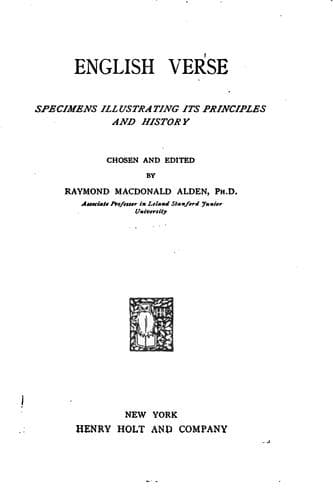
English Verse: Specimens Illustrating its Principles and HistoryAlden, Raymond MacDonald
General
English Verse: Specimens Illustrating its Principles and History
Alden, Raymond MacDonald
English language -- Versification; English poetry
(DRYDEN: _All for Love_, III. i. 1678.)
The first of these specimens of Dryden's blank verse illustrates the
loose form of it found in many of the comedies, ill distinguished from
prose and used interchangeably with prose, as in the case of the late
Jacobean dramatists. It was with _All for Love_ that Dryden dropped the
use of the rimed couplet in tragedy, and turned his hand toward the
construction of really noble blank verse. This play was professedly an
imitation of Shakspere, and the passage here quoted is a paraphrase of
one in _Antony and Cleopatra_, II. ii. Shakspere's blank verse doubtless
exerted a good influence on the quality of Dryden's. "From this time
on," says Mr. Gosse, "Dryden's blank verse was more severe than any
which had been used, except by Milton, since Ben Jonson." (_Eighteenth
Century Literature_, p. 14.)
Then hear me, bounteous Heaven!
Pour down your blessings on this beauteous head,
Where everlasting sweets are always springing:
With a continual-giving hand, let peace,
Honor, and safety always hover round her;
Feed her with plenty; let her eyes ne'er see
A sight of sorrow, nor her heart know mourning:
Crown all her days with joy, her nights with rest
Harmless as her own thoughts, and prop her virtue
To bear the loss of one that too much loved;
And comfort her with patience in our parting....
--Then hear me too, just Heaven!
Pour down your curses on this wretched head,
With never-ceasing vengeance; let despair,
Danger, or infamy, nay, all surround me.
Starve me with wantings; let my eyes ne'er see
A sight of comfort, nor my heart know peace;
But dash my days with sorrow, nights with horrors
Wild as my own thoughts now, and let loose fury
To make me mad enough for what I lose,
If I must lose him--if I must! I will not.
(THOMAS OTWAY: _Venice Preserved_, V. ii. 1682.)
This play was one of those marking the return of the serious drama to
blank verse, after the brief domination of the couplet on the stage.
While Otway's verse is not as good as Dryden's best, it is of fairly
even merit, and shows that something had been learned from the practice
of the couplet.
Public-domain text, read in full here on John Shaqi.
Reviews
Reviews
No reviews yet
Be the first to share your thoughts on this work.
Elsewhere in the archive
Join the Discussion
Join the discussion
Sign in to leave a comment or review.
Sign InorCreate an account