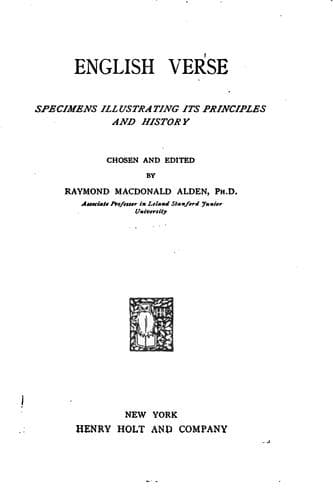
English Verse: Specimens Illustrating its Principles and HistoryAlden, Raymond MacDonald
General
English Verse: Specimens Illustrating its Principles and History
Alden, Raymond MacDonald
English language -- Versification; English poetry
"O all fresh out of beautiful sunlight."
"Agamemnon bowed over, and from his wheel."
"And to dispel shadows and shadowy fear."
"My bloom faded, and waning light of eyes."
For a criticism of Mr. Phillips's verse, see Mr. William Archer's _Poets
of the Younger Generation_, pp. 313-327.
FOOTNOTES:
[19] One may easily find other instances of the sporadic appearance of
the same measure in the midst of irregular "long lines" or rough
alexandrines and septenaries. Compare, for example, the following, from
early plays in Manly's _Specimens of the Pre-Shaksperean Drama_:
"To be alone, nor very convenyent." "Ye shall not touche yt, for that I
forbede." "But ye shuld be as godes resydent." "And many a chaumbyr thou
xalt have therinne." "In this flood spylt is many a mannys blood."
"Therfore be we now cast in ryght grett care."
The context of many of these lines shows that they were intended to be
read as four-stress rather than five-stress; but such examples serve to
make clear how easily English rhythm would fall into the decasyllabic
line.
[20] See also an account of Zarncke's monograph (1865) _Ueber den
fünffussiger Iambus_, in Mayor's _Chapters on English Metre_,
Postscript.
[21] See the entire Preface in Chalmers's _English Poets_, vol. viii. p.
32, and in the Appendix to Gosse's _From Shakespeare to Pope_. For an
analysis of Waller's verse with reference to this Preface, see "A Note
upon Waller's Distich," by H. C. Beeching, in the Furnivall _Miscellany_
(1901), p. 4.
[22] Beaumont's own verse is of no little interest, and Mr. Gosse, in a
recent letter to the present editor, observes that he finds in Beaumont,
"far more definitely than in George Sandys, the principal precursor of
Waller."
[23] See also the verses of Oliver Wendell Holmes on _The Strong Heroic
Line_ (in Stedman's _American Anthology_, p. 161), where he says:
"Nor let the rhymester of the hour deride The straight-backed measure
with its stately stride: It gave the mighty voice of Dryden scope; It
sheathed the steel-bright epigrams of Pope; In Goldsmith's verse it
learned a sweeter strain; Byron and Campbell wore its clanking chain; I
smile to listen while the critic's scorn Flouts the proud purple kings
have nobly worn."
[24] On the verse of Keats in general, see the remarks of Mr. Robert
Bridges in his Introduction to the Muses' Library edition of Keats.
[25] On Shelley's metres, see Mayor's _Chapters on English Metre_, 2d
ed., chap. xiv.
Public-domain text, read in full here on John Shaqi.
Reviews
Reviews
No reviews yet
Be the first to share your thoughts on this work.
Elsewhere in the archive
Join the Discussion
Join the discussion
Sign in to leave a comment or review.
Sign InorCreate an account