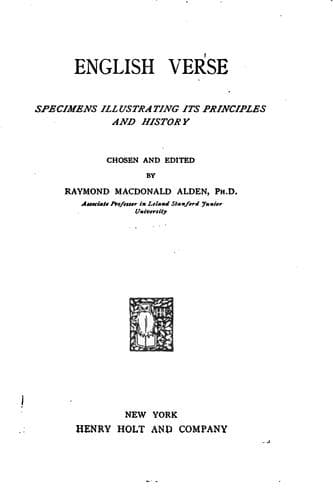
English Verse: Specimens Illustrating its Principles and HistoryAlden, Raymond MacDonald
General
English Verse: Specimens Illustrating its Principles and History
Alden, Raymond MacDonald
English language -- Versification; English poetry
[26] On the verse of Surrey in general, see W. J. Courthope, in his
_History of English Poetry_, vol. ii. pp. 92-96. Mr. Courthope speaks
highly of Surrey as a metrist, in particular attributing to him certain
reforms in the handling of English verse: the attempt to use five
perfect iambic feet to the line, the harmonious placing of the cesura,
the avoidance of rime on weak syllables, the preservation of the accent
on the even-numbered syllables. (To some of these reforms, as has been
indicated, there are not a few exceptions.) In like manner ten Brink
observes that Surrey "is more successful than Wyatt in adapting foreign
rules to the rhythmical accent of the English language, and thus he is
in reality the founder of the New-English metrical system." (_English
Literature_, Kennedy trans., vol. iii. p. 243.)
On the blank verse of Surrey, see also an article by Prof. O. J.
Emerson, in _Modern Language Notes_, vol. iv. col. 466, and Mayor's
_Chapters on English Metre_, 2d ed., chap. x.
[27] The edition of 1616 has:
"One drop of blood will save me: O my Christ! Rend not my heart for
naming of my Christ!"
and omits the preceding line.
(See Bullen ed., vol. i. pp. 279, 280.)
[28] On Marlowe's verse see also Mayor's _Chapters on English Metre_, 2d
ed., chap. x.
[29] On the technical problems of Shakspere's verse, see Fleay's
_Shakspere Manual_; Abbott's _Shakespearean Grammar_; G. Browne's _Notes
on Shakspere's Versification_; and Mayor's _Chapters on English Metre_.
[30] "In a play of 2500 lines Massinger might possibly have as many as
1200 double or triple endings, Shakspere in his last period might have
as many as 850, while Fletcher would normally have at least 1700, and
might not improbably give as many as 2000." (G. C. Macaulay, in _Francis
Beaumont_, pp. 43, 44. See the entire passage on Fletcher's metre as a
test of authorship. Mr. Macaulay also remarks interestingly that
Fletcher's metrical style is an outgrowth of his general use of the
loose or disjointed, as opposed to the periodic or rounded, style of
speech. To this "Shakspere worked his way slowly," while Fletcher "seems
to have at once and naturally adopted" it.) See also Fleay's
_Shakespeare Manual_, p. 153.
[31] On Massinger's verse see also Fleay's _Shakespeare Manual_, p. 154.
Public-domain text, read in full here on John Shaqi.
Reviews
Reviews
No reviews yet
Be the first to share your thoughts on this work.
Elsewhere in the archive
Join the Discussion
Join the discussion
Sign in to leave a comment or review.
Sign InorCreate an account