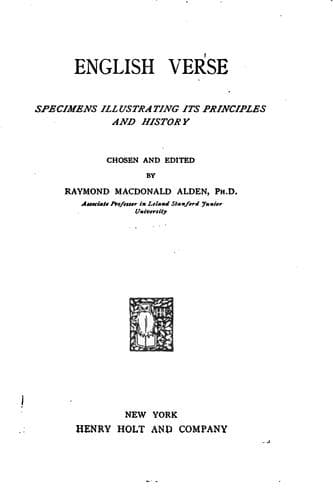
English Verse: Specimens Illustrating its Principles and HistoryAlden, Raymond MacDonald
General
English Verse: Specimens Illustrating its Principles and History
Alden, Raymond MacDonald
English language -- Versification; English poetry
The longe love that in my thought I harber,
And in my heart doth kepe his residence,
Into my face preaseth with bold pretence,
And there campeth, displaying his banner.
She that me learns to love, and to suffer,
And willes that my trust, and lustes negligence
Be reined by reason, shame, and reverence,
With his hardinesse takes displeasure.
Wherwith love to the hartes forest he fleeth,
Leavyng his enterprise with paine and crye,
And there him hideth and not appeareth.
What may I do? when my maister feareth,
But in the field with him to live and dye,
For good is the life, endyng faithfully.
(SIR THOMAS WYATT: _The lover hideth his desire_, etc., in Tottel's
_Songs and Sonnets_, p. 33. pub. 1557.)
It was Wyatt who introduced the sonnet into England. Thirty-one of his
sonnets were published in Tottel's Miscellany, of which about a third
are said to be translations or paraphrases of Petrarch's. Wyatt
followed, of course, the regular Italian structure, but used
unhesitatingly the form of sestet with the concluding couplet
(_cddcee_). On this point Mr. Courthope says: "Wyatt was evidently
unaware of the secret principle underlying the extremely complex
structure of the Italian sonnet; ... and being unfortunately misled by
his admiration for the _Strambotti_ of Serafino, which sum up the
conclusion in a couplet, he endeavored to construct his sonnets on the
same principle, thereby leading all sonnet writers before Milton on a
wrong path." (_History of English Poetry_, vol. ii. p. 91.)
Loving in truth, and fain in verse my love to show,
That she, dear she, might take some pleasure of my pain,--
Pleasure might cause her read, reading might make her know,
Knowledge might pity win, and pity grace obtain,--
I sought fit words to paint the blackest face of woe;
Studying inventions fine, her wits to entertain,
Oft turning others' leaves, to see if thence would flow
Some fresh and fruitful showers upon my sun-burn'd brain.
But words came halting forth, wanting Invention's stay;
Invention, Nature's child, fled step-dame Study's blows,
And others' feet still seem'd but strangers in my way.
Thus, great with child to speak, and helpless in my throes,
Biting my truant pen, beating myself for spite,--
'Fool,' said my Muse to me, 'Look in thy heart, and write.'
(SIR PHILIP SIDNEY: _Astrophel and Stella_, i. ab. 1580.)
Public-domain text, read in full here on John Shaqi.
Reviews
Reviews
No reviews yet
Be the first to share your thoughts on this work.
Elsewhere in the archive
Join the Discussion
Join the discussion
Sign in to leave a comment or review.
Sign InorCreate an account