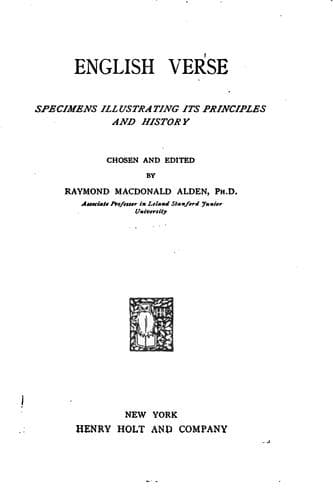
English Verse: Specimens Illustrating its Principles and HistoryAlden, Raymond MacDonald
General
English Verse: Specimens Illustrating its Principles and History
Alden, Raymond MacDonald
English language -- Versification; English poetry
With how sad steps, O Moon, thou climb'st the skies!
How silently, and with how wan a face!
What, may it be that e'en in heavenly place
That busy archer his sharp arrows tries!
Sure, if that long-with-love-acquainted eyes
Can judge of love, thou feel'st a lover's case,
I read it in thy looks; thy languish'd grace,
To me, that feel the like, thy state descries.
Then, e'en of fellowship, O Moon, tell me,
Is constant love deem'd there but want of wit?
Are beauties there as proud as here they be?
Do they above love to be loved, and yet
Those lovers scorn whom that love doth possess?
Do they call virtue, there, ungratefulness?
(SIR PHILIP SIDNEY: _Astrophel and Stella_, xxxi. ab. 1580.)
Sidney's favorite form for the sonnet sestet was that shown in these
specimens (_cdcdee_), a form that suggests the influence of the Surrey
or English sonnet rather than the Italian. The first of the sonnets is
of course exceptional in being written in alexandrines, but is among the
finest in the sequence. See also Sidney's sonnet of the English type, p.
291, below.
The _Astrophel and Stella_ (containing 110 sonnets) is the earliest of
the great sonnet-sequences or sonnet-cycles of English poetry, those of
Spenser, Shakspere, Rossetti, and Mrs. Browning being later
representatives. In the Elizabethan age the fashion of writing sonnets,
and sonnet-sequences in particular, was at its height, especially in the
last decade of the century (1590-1600). On this subject, see the
Introduction to Professor Schelling's _Elizabethan Lyrics_, in the
Athenæum Press Series, and Mr. Sidney Lee's _Life of Shakspere_. Other
noteworthy sonnet-sequences besides those of Sidney, Spenser, and
Shakspere were Constable's _Diana_, Daniel's _Delia_, Lodge's _Phyllis_,
Watson's _Tears of Fancy_, Barnes's _Parthenophil_, Giles Fletcher's
_Lycia_, and Drayton's _Idea_,--all published in the years 1592-1594. A
now forgotten poet by the name of Lok produced more than four hundred
sonnets, proving himself an Elizabethan rival to Wordsworth.
I know that all beneath the moon decays,
And what by mortals in this world is brought
In time's great periods shall return to naught;
That fairest states have fatal nights and days.
I know how all the Muse's heavenly lays,
With toil of spirit which are so dearly bought,
As idle sounds, of few or none are sought;
And that naught lighter is than airy praise.
I know frail beauty like the purple flower,
To which one morn oft birth and death affords;
That love a jarring is of minds' accords,
Where sense and will invassall reason's power.
Know what I list, this all can not me move,
But that, O me! I both must write and love.
(WILLIAM DRUMMOND of Hawthornden: _Sense of the Fragility of All
Things_, etc. 1616.)
Public-domain text, read in full here on John Shaqi.
Reviews
Reviews
No reviews yet
Be the first to share your thoughts on this work.
Elsewhere in the archive
Join the Discussion
Join the discussion
Sign in to leave a comment or review.
Sign InorCreate an account