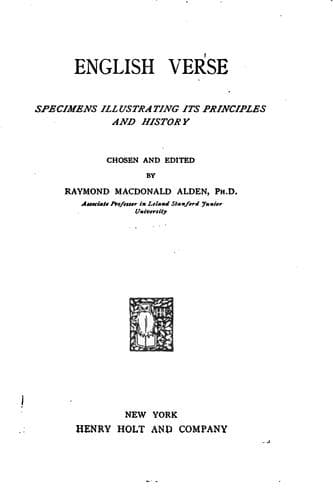
English Verse: Specimens Illustrating its Principles and HistoryAlden, Raymond MacDonald
General
English Verse: Specimens Illustrating its Principles and History
Alden, Raymond MacDonald
English language -- Versification; English poetry
"My heart has thanked thee, Bowles! for those soft strains
Whose sadness soothes me."
His sonnets were, however, neglectful of the regular Italian structure,
so that under his influence, as Leigh Hunt observed, "the illegitimate
order ... became such a favorite with lovers of easy writing who could
string fourteen lines together, that ... it continued to fill the press
with heaps of bad verses, till the genius of Wordsworth succeeded in
restoring the right system." (_Essay on the Sonnet_, p. 85.) But see the
notes on Wordsworth's sonnets, p. 280, below.
Mary! I want a lyre with other strings,
Such aid from Heaven as some have feigned they drew,
An eloquence scarce given to mortals, new
And undebased by praise of meaner things,
That, ere through age or woe I shed my wings,
I may record thy worth with honor due,
In verse as musical as thou art true,
And that immortalizes whom it sings.
But thou hast little need. There is a book
By Seraphs writ with beams of heavenly light,
On which the eyes of God not rarely look,
A chronicle of actions just and bright:
There all thy deeds, my faithful Mary, shine,
And, since thou own'st that praise, I spare thee mine.
(COWPER: _To Mrs. Unwin_. 1793.)
Nuns fret not at their convent's narrow room;
And hermits are contented with their cells;
And students with their pensive citadels;
Maids at the wheel, the weaver at his loom,
Sit blithe and happy; bees that soar for bloom,
High as the highest peak of Furness Fells,
Will murmur by the hour in foxglove bells.
In truth the prison unto which we doom
Ourselves no prison is; and hence to me,
In sundry moods, 'twas pastime to be bound
Within the sonnet's scanty plot of ground,
Pleased if some souls (for such there needs must be)
Who have felt the weight of too much liberty,
Should find brief solace there, as I have found.
(WORDSWORTH: _The Sonnet_. 1806.)
Scorn not the Sonnet; Critic, you have frowned,
Mindless of its just honors; with this key
Shakspere unlocked his heart; the melody
Of this small lute gave ease to Petrarch's wound;
A thousand times this pipe did Tasso sound;
With it Camoens soothed an exile's grief;
The Sonnet glittered a gay myrtle leaf
Amid the cypress with which Dante crowned
His visionary brow: a glow-worm lamp,
It cheered mild Spenser, called from Faery-land
To struggle through dark ways; and, when a damp
Fell round the path of Milton, in his hand
The Thing became a trumpet, whence he blew
Soul-animating strains--alas, too few!
(WORDSWORTH: _Scorn not the Sonnet_. 1827.)
Public-domain text, read in full here on John Shaqi.
Reviews
Reviews
No reviews yet
Be the first to share your thoughts on this work.
Elsewhere in the archive
Join the Discussion
Join the discussion
Sign in to leave a comment or review.
Sign InorCreate an account