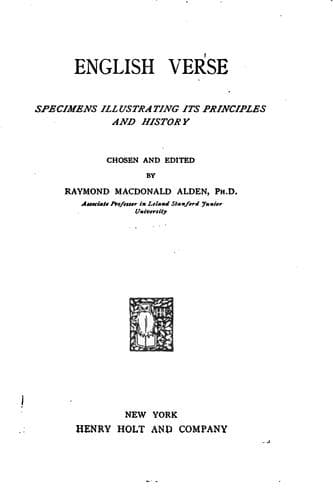
English Verse: Specimens Illustrating its Principles and HistoryAlden, Raymond MacDonald
General
English Verse: Specimens Illustrating its Principles and History
Alden, Raymond MacDonald
English language -- Versification; English poetry
"The Thing became a trumpet, whence he blew
Soul-animating strains--alas, too few!"
Besides the eighteen English sonnets in regular form, Milton wrote a
"tailed," or "caudated," sonnet, following an Italian fashion,--"On the
New Forcers of Conscience under the Long Parliament." "He intended it,"
says Masson, "to be what may be called an Anti-Presbyterian and
Pro-Toleration Sonnet; but by going beyond fourteen lines, converted it
into what the Italians called a 'sonnet with a tail.'" (Globe ed., p.
440.) The "tail" rimes _cfffgg_.
Deem not devoid of elegance the sage,
By Fancy's genuine feelings unbeguiled,
Of painful pedantry the poring child,
Who turns, of these proud domes, th' historic page,
Now sunk by Time, and Henry's fiercer rage.
Think'st thou the warbling Muses never smiled
On his lone hours? Ingenuous views engage
His thoughts, on themes, unclassic falsely styled,
Intent. While cloistered Piety displays
Her mouldering roll, the piercing eye explores
New manners, and the pomp of elder days,
Whence culls the pensive bard his pictured stores.
Nor rough nor barren are the winding ways
Of hoar Antiquity, but strown with flowers.
(THOMAS WARTON: _In a Blank Leaf of Dugdale's 'Monasticon.'_ ab. 1775.)
After Milton, the sonnet fell into disuse for a century. "Walsh," says
Mr. Gosse, "is the author of the only sonnet written in English between
Milton's, in 1658, and Warton's, about 1750." (Ward's _English Poets_,
vol. iii. p. 7.) See, however, that of Gray on West, written in 1742,
quoted p. 295, below. To the Warton brothers, pioneers in so many ways
of the romantic revival, chief credit is given for the revival of the
sonnet in the eighteenth century. Other sonneteers of the period were
William Mason, Thomas Edwards, Benjamin Stillingfleet, and Thomas
Russell (see Seccombe's _Age of Johnson_, pp. 254, 255, and Beers's
_English Romanticism in the Eighteenth Century_, pp. 160, 161).
O Time! who know'st a lenient hand to lay
Softest on sorrow's wound, and slowly thence
(Lulling to sad repose the weary sense)
The faint pang stealest, unperceived, away;
On thee I rest my only hope at last,
And think when thou hast dried the bitter tear
That flows in vain o'er all my soul held dear,
I may look back on every sorrow past,
And meet life's peaceful evening with a smile.
As some lone bird, at day's departing hour,
Sings in the sunbeam, of the transient shower
Forgetful, though its wings are wet the while:
Yet ah! how much must that poor heart endure
Which hopes from thee, and thee alone, a cure!
(WILLIAM LISLE BOWLES: _To Time_. 1789.)
Bowles (1762-1850) wrote numerous sonnets, and was influential in
carrying on the movement begun by the Wartons. His sonnets were admired,
in particular, by Coleridge and Wordsworth, the former poet dedicating
to him a sonnet beginning:
Public-domain text, read in full here on John Shaqi.
Reviews
Reviews
No reviews yet
Be the first to share your thoughts on this work.
Elsewhere in the archive
Join the Discussion
Join the discussion
Sign in to leave a comment or review.
Sign InorCreate an account