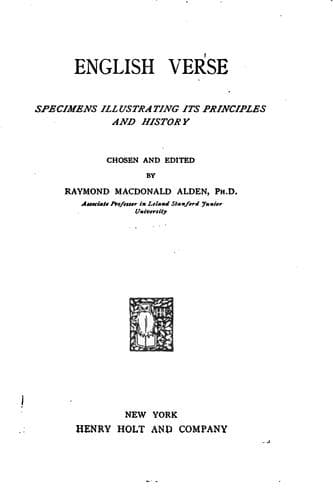
English Verse: Specimens Illustrating its Principles and HistoryAlden, Raymond MacDonald
General
English Verse: Specimens Illustrating its Principles and History
Alden, Raymond MacDonald
English language -- Versification; English poetry
The sonnets of Rossetti are undoubtedly the most perfect representatives
of the Italian form in English poetry of the nineteenth century, and
_The House of Life_ (in 101 sonnets) is probably to be regarded as the
most important sonnet-sequence since the Elizabethan age. The bipartite
character of Rossetti's sonnets is marked, in editions of his poems, by
the printing of the octave and sestet with a space between them.
They rose to where their sovran eagle sails,
They kept their faith, their freedom, on the height,
Chaste, frugal, savage, armed by day and night
Against the Turk; whose inroad nowhere scales
Their headlong passes, but his footstep fails,
And red with blood the Crescent reels from fight
Before their dauntless hundreds, in prone flight
By thousands down the crags and through the vales.
O smallest among peoples! rough rock-throne
Of Freedom! warriors beating back the swarm
Of Turkish Islam for five hundred years,
Great Tsernagora! never since thine own
Black ridges drew the cloud and brake the storm
Has breathed a race of mightier mountaineers.
(TENNYSON: _Montenegro_. 1877.)
It is curious that the two chief representatives of English poetry of
the Victorian period, Tennyson and Browning, should neither of them have
given much attention to the sonnet nor have achieved any notable success
in the form. Among Tennyson's poems there are some seventeen sonnets, of
which the present specimen was considered by the poet to be the best. It
represents a common form of the bipartite structure, where the octave is
a narrative, and the sestet a comment upon what has been narrated. In
the following specimen, from Matthew Arnold, the structure is similar.
Lentzner quotes the _East London_, in his monograph on the English
sonnet, as a case where the octave represents the thought in particular,
the sestet in the abstract; in other cases the order is the reverse.
'Twas August, and the fierce sun overhead
Smote on the squalid streets of Bethnal Green,
And the pale weaver, through his window seen
In Spitalfields, looked thrice dispirited.
I met a preacher there I knew, and said:
'Ill and o'er-worked, how fare you in this scene?'
'Bravely!' said he, 'for I of late have been
Much cheered with thoughts of Christ, the Living Bread!'
O human soul! so long as thou canst so
Set up a mark of everlasting light
Above the howling senses' ebb and flow,
To cheer thee and to right thee if thou roam,
Not with lost toil thou laborest through the night!
Thou mak'st the heaven thou hop'st indeed thy home.
(MATTHEW ARNOLD: _East London_. 1867.)
Public-domain text, read in full here on John Shaqi.
Reviews
Reviews
No reviews yet
Be the first to share your thoughts on this work.
Elsewhere in the archive
Join the Discussion
Join the discussion
Sign in to leave a comment or review.
Sign InorCreate an account