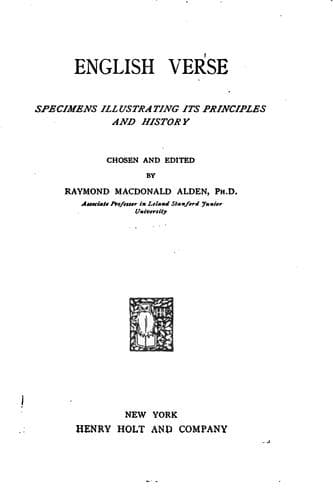
English Verse: Specimens Illustrating its Principles and HistoryAlden, Raymond MacDonald
General
English Verse: Specimens Illustrating its Principles and History
Alden, Raymond MacDonald
English language -- Versification; English poetry
"Why?" Because all I haply can and do,
All that I am now, all I hope to be,--
Whence comes it save from fortune setting free
Body and soul the purpose to pursue,
God traced for both? If fetters, not a few,
Of prejudice, convention, fall from me,
These shall I bid men--each in his degree
Also God-guided--bear, and gayly too?
But little do or can the best of us:
That little is achieved through Liberty.
Who, then, dares hold, emancipated thus--
His fellow shall continue bound? Not I.
Who live, love, labor freely, nor discuss
A brother's right to freedom. That is "Why."
(BROWNING: _Why I am a Liberal_. 1885.)
Browning's sonnets are few in number, mostly occasional, and none of
them can be considered notable. For a study of them, see the article by
Lentzner in _Anglia_, vol. xi. p. 500. Dr. Lentzner includes nine in his
list, not all of which are included in Browning's collected poems. Three
are so closely connected as practically to form a poem in three stanzas
(appended to _Jochanan Hakkadosh_, 1883).
One saith: the whole world is a Comedy
Played for the mirth of God upon his throne,
Whereof the hidden meanings will be known
When Michael's trumpet thrills through earth and sea.
Fate is the dramaturge; Necessity
Allots the parts; the scenes, by Nature shown,
Embrace each element and every zone,
Ordered with infinite variety.Another
saith: no calm-eyed Sophocles
Indites the tragedy of human doom,
But some cold scornful Aristophanes,
Whose zanies gape and gibber in thick gloom,
While nightingales, shrill 'mid the shivering trees,
Jar on the silence of the neighboring tomb.
(JOHN ADDINGTON SYMONDS: from _Sonnets on the Thought of Death_. ab.
1880.)
Yon silvery billows breaking on the beach
Fall back in foam beneath the star-shine clear,
The while my rhymes are murmuring in your ear
A restless lore like that the billows teach;
For on these sonnet-waves my soul would reach
From its own depths, and rest within you, dear,
As, through the billowy voices yearning here,
Great Nature strives to find a human speech.
A sonnet is a wave of melody:
From heaving waters of the impassioned soul
A billow of tidal music one and whole
Flows in the octave; then, returning free,
Its ebbing surges in the sestet roll
Back to the deeps of Life's tumultuous sea.
(THEODORE WATTS-DUNTON: _The Sonnet's Voice; a Metrical Lesson by the
Sea-shore_. _Athenæum_, Sept. 17, 1881.)
The "sonnet on the sonnet" has become so familiar in recent times that a
volume of such sonnets has been compiled, and a writer of humorous verse
has satirized the fashion in a "Sonnet on the Sonnet on the Sonnet."
Doubtless the two specimens quoted from Wordsworth lead all others of
the class; but the present specimen is an interesting attempt to
represent the characteristic metrical expressiveness of the form.
Public-domain text, read in full here on John Shaqi.
Reviews
Reviews
No reviews yet
Be the first to share your thoughts on this work.
Elsewhere in the archive
Join the Discussion
Join the discussion
Sign in to leave a comment or review.
Sign InorCreate an account