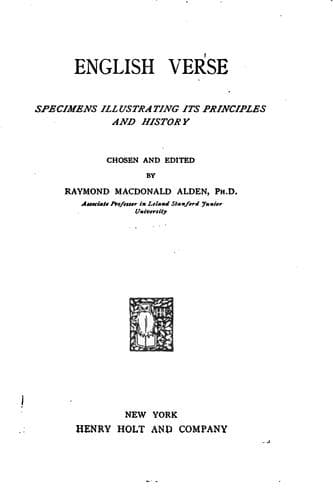
English Verse: Specimens Illustrating its Principles and HistoryAlden, Raymond MacDonald
General
English Verse: Specimens Illustrating its Principles and History
Alden, Raymond MacDonald
English language -- Versification; English poetry
This ode of Jonson's is apparently the earliest, and remained for a long
time the only, notable English ode based on the strict structure of the
Greek original. The Greek ode was commonly divided into the strophe, the
antistrophe, and the epode; the strophe and antistrophe being identical
in structure, though varying in different odes, and the epode being of
different structure. Jonson therefore followed the classical form
carefully, and introduced English terms to express the original three
divisions.
Professor Bronson observes, in his Introduction to the Odes of Collins:
"It is a commonplace that the Pindaric Ode in English is an artificial
exotic, of slight native force, and unable to reproduce the effects of
the Greek original. The reason is obvious. The Greek odes were
accompanied by music and dancing, the singers moving to one side during
the strophe, retracing their steps during the antistrophe, ... and
standing still during the epode. The ear was thus helped by the eye, and
the divisions of the ode were distinct and significant. But in an
English Pindaric the elaborate correspondences and differences between
strophe, antistrophe, and epode are lost upon most readers, and even the
critical reader derives from them a pleasure intellectual rather than
sensuous." (Edition of Collins, Athenæum Press Series, Introduction, pp.
lxxiv, lxxv.)
I^{1}
Daughter of Memory, immortal Muse,
Calliope, what poet wilt thou choose,
Of Anna's name to sing?
To whom wilt thou thy fire impart,
Thy lyre, thy voice, and tuneful art,
Whom raise sublime on thy ethereal wing,
And consecrate with dews of thy Castalian spring?
I^{2}
Without thy aid, the most aspiring mind
Must flag beneath, to narrow flights confin'd,
Striving to rise in vain;
Nor e'er can hope with equal lays
To celebrate bright Virtue's praise.
Thine aid obtain'd, even I, the humblest swain,
May climb Pierian heights, and quit the lowly plain.
I^{3}
High in the starry orb is hung,
And next Alcides' guardian arm,
That harp to which thy Orpheus sung,
Who woods and rocks and winds could charm;
That harp which on Cyllene's shady hill,
When first the vocal shell was found,
With more than mortal skill
Inventor Hermes taught to sound:
Hermes on bright Latona's son,
By sweet persuasion won,
The wondrous work bestow'd;
Latona's son, to thine
Indulgent, gave the gift divine:
A god the gift, a god th' invention show'd.
(CONGREVE: _A Pindaric Ode on the victorious progress of her Majesty's
Arms_. 1706.)
Public-domain text, read in full here on John Shaqi.
Reviews
Reviews
No reviews yet
Be the first to share your thoughts on this work.
Elsewhere in the archive
Join the Discussion
Join the discussion
Sign in to leave a comment or review.
Sign InorCreate an account