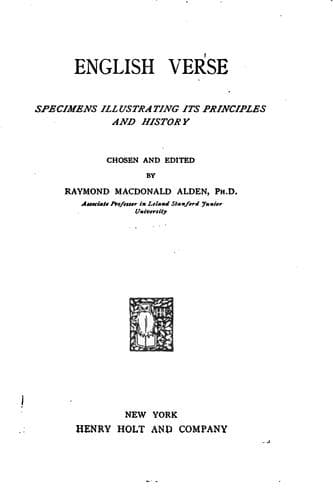
English Verse: Specimens Illustrating its Principles and HistoryAlden, Raymond MacDonald
General
English Verse: Specimens Illustrating its Principles and History
Alden, Raymond MacDonald
English language -- Versification; English poetry
To Congreve is due the credit for the revival of the regular ode in the
eighteenth century, after it had been long forgotten by English poets.
Meantime the irregular form, devised by Cowley, had become popular; and
against the license of this Congreve protested in his _Discourse on the
Pindaric Ode_, prefixed to his Ode of 1706. (See Mr. Gosse's
Introduction to _English Odes_, p. xvii., and his _Life of Congreve_, p.
158.)
Congreve said in his Discourse: "The following ode is an attempt
towards restoring the regularity of the ancient lyric poetry, which
seems to be altogether forgotten, or unknown, by our English
writers. There is nothing more frequent among us than a sort of
poems entitled Pindaric Odes, pretending to be written in imitation
of the manner and style of Pindar, and yet I do not know that there
is to this day extant, in our language, one ode contrived after his
model.... The character of these late Pindarics is a bundle of
rambling incoherent thoughts, expressed in a like parcel of
irregular stanzas, which also consist of such another complication
of disproportioned, uncertain, and perplexed verses and rhymes....
On the contrary, there is nothing more regular than the odes of
Pindar, both as to the exact observation of the measures and
numbers of his stanzas and verses, and the perpetual coherence of
his thoughts....
"Though there be no necessity that our triumphal odes should
consist of the three afore-mentioned stanzas, yet if the reader can
observe that the great variation of the numbers in the third stanza
(call it epode, or what you please) has a pleasing effect in the
ode, and makes him return to the first and second stanzas with more
appetite than he could do if always cloyed with the same quantities
and measures, I cannot see why some use may not be made of Pindar's
example, to the great improvement of the English ode. There is
certainly a pleasure in beholding anything that has art and
difficulty in the contrivance, especially if it appears so
carefully executed that the difficulty does not show itself till it
is sought for....
Public-domain text, read in full here on John Shaqi.
Reviews
Reviews
No reviews yet
Be the first to share your thoughts on this work.
Elsewhere in the archive
Join the Discussion
Join the discussion
Sign in to leave a comment or review.
Sign InorCreate an account