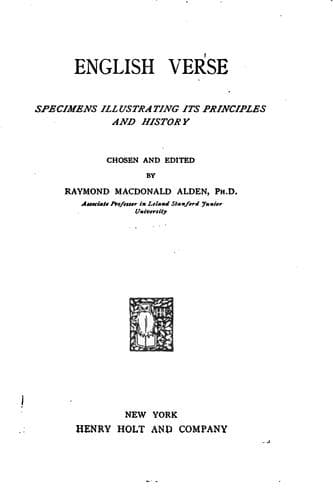
English Verse: Specimens Illustrating its Principles and HistoryAlden, Raymond MacDonald
General
English Verse: Specimens Illustrating its Principles and History
Alden, Raymond MacDonald
English language -- Versification; English poetry
In this poem the English ode may be said to have reached its high-water
mark. Professor Corson observes: "The several metres are felt, in the
course of the reading of the Ode, to be organic--inseparable from what
each is employed to express. The rhymes, too, with their varying
degrees of emphasis, according to the nearness or remoteness, and the
length, of the rhyming verses, are equally a part of the expression....
The feelings of the reader of English poetry get to be set, so to speak,
to the pentameter measure, as in that measure the largest portion of
English poetry is written; and, accordingly, other measures derive some
effect from that fact. In the theme-metre, generally, the more
reflective portions of the Ode, its deeper tones, are expressed. The
gladder notes come in the shorter metres.... Wordsworth never wrote any
poem of which it can be more truly said than of his great Ode, 'Of the
soul the body form doth take.'" (_Primer of English Verse_, pp. 32-34.)
Then gentle winds arose
With many a mingled close
Of wild Æolian sound and mountain-odor keen;
And where the Baian ocean
Welters with airlike motion,
Within, above, around its bowers of starry green,
Moving the sea-flowers in those purple caves
Even as the ever stormless atmosphere
Floats o'er the Elysian realm,
It bore me like an Angel, o'er the waves
Of sunlight, whose swift pinnace of dewy air
No storm can overwhelm;
I sailed, where ever flows
Under the calm Serene
A spirit of deep emotion
From the unknown graves
Of the dead kings of Melody.
Shadowy Aornos darkened o'er the helm
The horizontal ether; heaven stripped bare
Its depths over Elysium, where the prow
Made the invisible water white as snow;
From that Typhæan mount, Inarime,
There streamed a sunlight vapor, like the standard
Of some ethereal host;
Whilst from the coast,
Louder and louder, gathering round, there wandered
Over the oracular woods and divine sea
Prophesyings which grew articulate--
They seize me--I must speak them--be they fate!
(SHELLEY: _Ode to Naples_, strophe ii. 1819.)
Bury the Great Duke
With an empire's lamentation,
Let us bury the Great Duke
To the noise of the mourning of a mighty nation,
Mourning when their leaders fall,
Warriors carry the warrior's pall,
And sorrow darkens hamlet and hall.
Where shall we lay the man whom we deplore?
Here, in streaming London's central roar.
Let the sound of those he wrought for,
And the feet of those he fought for,
Echo round his bones for evermore.
Lead out the pageant: sad and slow,
As fits an universal woe,
Let the long long procession go,
And let the sorrowing crowd about it grow,
And let the mournful martial music blow;
The last great Englishman is low....
Public-domain text, read in full here on John Shaqi.
Reviews
Reviews
No reviews yet
Be the first to share your thoughts on this work.
Elsewhere in the archive
Join the Discussion
Join the discussion
Sign in to leave a comment or review.
Sign InorCreate an account