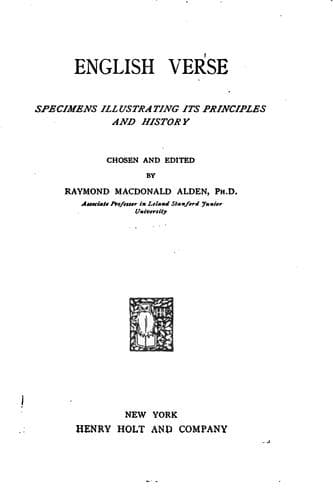
English Verse: Specimens Illustrating its Principles and HistoryAlden, Raymond MacDonald
General
English Verse: Specimens Illustrating its Principles and History
Alden, Raymond MacDonald
English language -- Versification; English poetry
... We revere, and while we hear
The tides of Music's golden sea
Setting toward eternity,
Uplifted high in heart and hope are we,
Until we doubt not that for one so true
There must be other nobler work to do
Than when he fought at Waterloo,
And Victor he must ever be.
For though the Giant Ages heave the hill
And break the shore, and evermore
Make and break, and work their will;
Though world on world in myriad myriads roll
Round us, each with different powers,
And other forms of life than ours,
What know we greater than the soul?
On God and Godlike men we build our trust.
Hush, the Dead March wails in the people's ears:
The dark crowd moves, and there are sobs and tears:
The black earth yawns: the mortal disappears;
Ashes to ashes, dust to dust;
He is gone who seemed so great.--
Gone; but nothing can bereave him
Of the force he made his own
Being here, and we believe him
Something far advanced in state,
And that he wears a truer crown
Than any wreath that man can weave him.
Speak no more of his renown,
Lay your earthly fancies down,
And in the vast cathedral leave him.
God accept him, Christ receive him.
(TENNYSON: _On the Death of the Duke of Wellington_, strophes i, ii,
iii, ix (in part). 1852.)
This ode of Tennyson's is one of the few poems in which he gave himself
such liberty of form (compare some of the irregular measures of _Maud_).
It shows his usual skill in the adaptation of metrical effects to the
purposes of description. Dr. Henry Van Dyke has suggested that the
varying--almost lawless--movements of the opening lines are designed to
suggest the surging of the crowd through the streets of London, before
the entrance into the cathedral for the funeral.
Bow down, dear Land, for thou hast found release!
Thy God, in these distempered days,
Hath taught thee the sure wisdom of His ways,
And through thine enemies hath wrought thy peace!
Bow down in prayer and praise!
No poorest in thy borders but may now
Lift to the juster skies a man's enfranchised brow.
O Beautiful! my Country! ours once more,
Smoothing thy gold of war-dishevelled hair
O'er such sweet brows as never other wore,
And letting thy set lips,
Freed from wrath's pale eclipse,
The rosy edges of their smile lay bare,
What words divine of lover or of poet
Could tell our love and make thee know it,
Among the Nations bright beyond compare?
What were our lives without thee?
What all our lives to save thee?
We reck not what we gave thee;
We will not dare to doubt thee.
But ask whatever else, and we will dare!
(LOWELL: _Harvard Commemoration Ode_, strophe xii. 1865.)
Public-domain text, read in full here on John Shaqi.
Reviews
Reviews
No reviews yet
Be the first to share your thoughts on this work.
Elsewhere in the archive
Join the Discussion
Join the discussion
Sign in to leave a comment or review.
Sign InorCreate an account