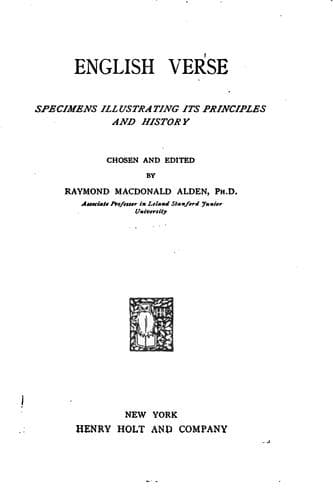
English Verse: Specimens Illustrating its Principles and HistoryAlden, Raymond MacDonald
General
English Verse: Specimens Illustrating its Principles and History
Alden, Raymond MacDonald
English language -- Versification; English poetry
Especially at least, of health that's great
The term's insatiable: for, its weight
--A neighbor, with a common wall between--
Ever will sickness lean;
And destiny, her course pursuing straight,
Has struck man's ship against a reef unseen.
Now, when a portion, rather than the treasure
Fear casts from sling, with peril in right measure,
It has not sunk--the universal freight,
(With misery freighted over-full,)
Nor has fear whelmed the hull.
Then too the gift of Zeus,
Two-handedly profuse,
Even from the furrows' yield for yearly use
Has done away with famine, the disease;
But blood of man to earth once falling,--deadly, black,--
In times ere these,--
Who may, by singing spells, call back?
Zeus had not else stopped one who rightly knew
The way to bring the dead again.
But, did not an appointed Fate constrain
The Fate from gods, to bear no more than due,
My heart, outstripping what tongue utters,
Would have all out: which now, in darkness, mutters
Moodily grieved, nor ever hopes to find
How she a word in season may unwind
From out the enkindling mind.
(BROWNING: _Agamemnon_; chorus. 1877.)
Of the same general metrical character as the irregular odes are certain
poems (like some of Patmore's) with no regularly organized structure and
varying lengths of line. See, for example, Milton's verses _At a Solemn
Music_ and _On Time_; Swinburne's _Thalassius_ and _On the Cliffs_; and
William Morris's _On a fair Spring Morning_. Compare, also, the effect
of the irregular strophic forms in Southey's _Curse of Kehama_,
Shelley's _Queen Mab_, and the like.[41]
FOOTNOTES:
[39] On English ode-forms, see the introductions to Mr. Gosse's _English
Odes_ and Mr. William Sharp's _Great Odes_; also Schipper, vol. ii. p.
792.
[40] Mr. Patmore has used the same sort of verse for narrative poetry,
with unusual daring but also with unusual success. For an example see
his _Amelia_, included in the _Golden Treasury_, Second Series. The
following passage exhibits the metrical method of the poem at its best:
"And so we went alone By walls o'er which the lilac's numerous plume
Shook down perfume; Trim plots close blown With daisies, in conspicuous
myriads seen, Engross'd each one With single ardor for her spouse, the
sun; Garths in their glad array Of white and ruddy branch, auroral, gay,
With azure chill the maiden flower between; Meadows of fervid green,
With sometime sudden prospect of untold Cowslips, like chance-found
gold; And broadcast buttercups at joyful gaze, Rending the air with
praise, Like the six-hundred-thousand-voiced shout Of Jacob camp'd in
Midian put to rout; Then through the Park, Where Spring to livelier
gloom Quickened the cedars dark, And, 'gainst the clear sky cold, Which
shone afar Crowded with sunny alps oracular, Great chestnuts raised
themselves abroad like cliffs of bloom."
Public-domain text, read in full here on John Shaqi.
Reviews
Reviews
No reviews yet
Be the first to share your thoughts on this work.
Elsewhere in the archive
Join the Discussion
Join the discussion
Sign in to leave a comment or review.
Sign InorCreate an account