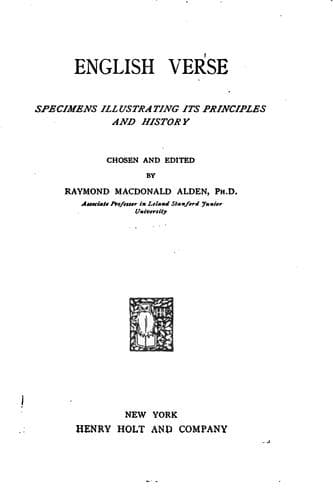
English Verse: Specimens Illustrating its Principles and HistoryAlden, Raymond MacDonald
General
English Verse: Specimens Illustrating its Principles and History
Alden, Raymond MacDonald
English language -- Versification; English poetry
The whole passage is well worth reading. The
best account of the movement toward classical versification in the
days of the "Areopagus" will be found in Professor Schelling's
_Poetic and Verse Criticism in the Reign of Elizabeth_
(Publications of the University of Pennsylvania).
O ye Nymphes most fine who resort to this brooke,
For to bathe there your pretty breasts at all times:
Leave the watrish bowres, hyther and to me come at my request nowe.
And ye Virgins trymme who resort to Parnass,
Whence the learned well Helicon beginneth:
Helpe to blase her worthy deserts, that all els mounteth above farre.
(WILLIAM WEBBE: Sapphic Verse, in _A Discourse of English Poetrie_.
1586.)
Webbe was another of those who believed "that if the true kind of
versifying in immitation of Greekes and Latines, had been practised in
the English tongue, ... it would long ere this have aspyred to as full
perfection, as in anie other tongue whatsoever." So he added to his
_Discourse_ (see Arber Reprint, pp. 67-84) a discussion of the
principles of quantitative prosody, and some specimens of what might be
done by way of experiment.[42] The Sapphics from which the present
specimen is taken are a paraphrase of Spenser's praise of Elizabeth in
the fourth eclogue of the _Shepherd's Calendar_. (For a specimen of
Webbe's hexameters, see p. 334, below.)
Greatest in thy wars,
Greater in thy peace,
Dread Elizabeth;
Our muse only truth,
Figments cannot use,
Thy ritch name to deck
That itselfe adorns:
But should now this age
Let all poesye fayne,
Fayning poesy could
Nothing faine at all
Worthy halfe thy fame.
(THOMAS CAMPION: Iambic Dimeter, "an example Lyrical," in _Observations
in the Art of English Poesie_. 1602.)
Rose-cheekt Lawra come
Sing thou smoothly with thy beawtie's
Silent musick, either other
Sweetely gracing.
Lovely formes do flowe
From concent devinely framed,
Heav'n is musick, and thy beawtie's
Birth is heavenly.
(THOMAS CAMPION: Trochaic Dimeter, _ib._)
The full title of Campion's work was: "Observations in the Art of
English Poesie; wherein it is demonstratively proved, and by example
confirmed, that the English toong will receive eight severall kinds of
numbers, proper to it selfe, which are all in this booke set forth, and
were never before this time by any man attempted." Campion, like other
classical versifiers, condemned rime as a barbarity; but in imitating
the classical measures he does not violate the normal English accent, so
that his verses read smoothly in English rhythm. Curiously enough, he
includes among his innovations an iambic measure which proves to be
ordinary decasyllabic verse:
"Goe numbers boldly passe, stay not for ayde
Of shifting rime, that easie flatterer,
Whose witchcraft can the ruder eares beguile".
Public-domain text, read in full here on John Shaqi.
Reviews
Reviews
No reviews yet
Be the first to share your thoughts on this work.
Elsewhere in the archive
Join the Discussion
Join the discussion
Sign in to leave a comment or review.
Sign InorCreate an account