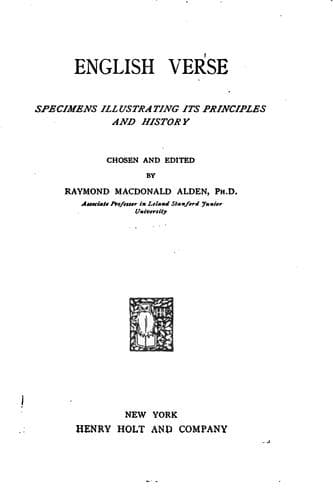
English Verse: Specimens Illustrating its Principles and HistoryAlden, Raymond MacDonald
General
English Verse: Specimens Illustrating its Principles and History
Alden, Raymond MacDonald
English language -- Versification; English poetry
Sidney was a member of the little group of classical students who called
themselves the "Areopagus," and who were interested in introducing
classical measures into English verse. Others of the group were Gabriel
Harvey and Edmund Spenser, from whose correspondence most of our
information regarding the movement is derived. (See the letters in
Grosart's edition of Harvey's Works, vol. i. pp. 7-9, 20-24, 35-37,
75-76, 99-107.) Spenser's only known efforts in the same direction are
also preserved in this correspondence; a poem in twenty-one iambic
trimeters, and this "tetrasticon":--
"See yee the blindfoulded pretie god, that feathered archer,
Of lovers miseries which maketh his bloodie game?
Wote ye why his moother with a veale hath coovered his face?
Trust me, least he my loove happely chaunce to beholde."
It would seem that Spenser was attempting, more conscientiously than
Sidney did, to follow the classical rules of quantity in making his
verses; hence they are more difficult to read according to English
rhythm. Sidney's experiments in the classical versification are perhaps
the most successful, to modern taste, of all those made in the
Elizabethan period. Among the other songs in the _Arcadia_ will be found
sapphics and hexameters.
See especially Spenser's letter of April, 1580, and Harvey's reply
(_op. cit._, vol. i. pp. 35, 99), for notable passages indicating
the seriousness with which the members of the "Areopagus" were
trying to orm English verse so as to bring it under the rules of
classical prosody. The relations of quantity and accent were not
understood, as indeed they may be said still not to be understood
for the English language. Spenser suggests, in a frequently quoted
passage, that in the word _carpenter_ the middle syllable is "short
in speech, when it shall be read long in verse,"--that is, because
the vowel is followed by two consonants; hence it "seemeth like a
lame gosling that draweth one legge after her.... But it is to be
wonne with custome, and rough words must be subdued with use."
Harvey resented the idea that the common pronunciation of words
could be departed from in order to conform them to arbitrary
metrical rules, and in his reply said: "You shall never have my
subscription or consent ... to make your Carpēnter our
Carpĕnter, an inche longer or bigger, than God and his Englishe
people have made him.... Else never heard I any that durst presume
so much over the Englishe ... as to alter the quantitie of any one
sillable, otherwise than oure common speache and generall receyved
custome woulde beare them oute." But while all English verse must
be consistent with "the vulgare and naturall mother prosodye,"
Harvey does not despair of finding a system that shall be at the
same time "countervaileable to the best tongues" in making possible
quantitative verse.
Public-domain text, read in full here on John Shaqi.
Reviews
Reviews
No reviews yet
Be the first to share your thoughts on this work.
Elsewhere in the archive
Join the Discussion
Join the discussion
Sign in to leave a comment or review.
Sign InorCreate an account