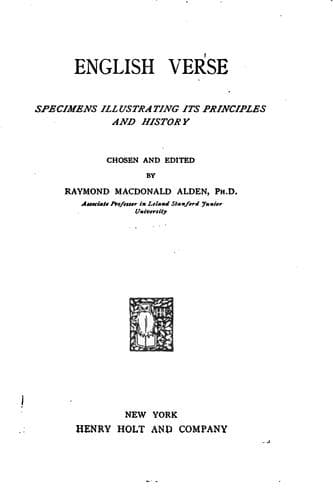
English Verse: Specimens Illustrating its Principles and HistoryAlden, Raymond MacDonald
General
English Verse: Specimens Illustrating its Principles and History
Alden, Raymond MacDonald
English language -- Versification; English poetry
Says Mr. Gleeson White: "The taste for these _tours de force_ in the art
of verse-making is no doubt an acquired one; yet to quote the first
attempt to produce a lyric with a repeated burden would take one back to
the earliest civilization.... Whether the first refrains were used for
decorative effect only, or to give the singer time to recollect or
improvise the next verse, it matters little, since the once mere adjunct
was made in later French use an integral and vital part of the verse.
The charm of these strictly written verses is undoubtedly increased by
some knowledge of their technical rules.... To approach ideal
perfection, nothing less than implicit obedience to all the rules is the
first element of success; but the task is by no means finished there.
Every quality that poetry demands, whether clearness of thought,
elegance of expression, harmonious sound, or faultless rhythm, is needed
as much in these shapes as in unfettered verse.... It may be said,
without fear of exaggeration, that all the qualities required to form a
perfect lyric in poetry are equally needful here, _plus_ a great many
special ones the forms themselves demand. To the students of any art
there is always a peculiar charm when the highest difficulties are
surmounted with such ease that the consummate art is hidden to all who
know not the magic password to unveil it." (_Ballades and Rondeaus_,
Introduction, pp. xli, xlii.) "No one is compelled to use these complex
forms, but if chosen, their laws must be obeyed to the letter if success
is to be obtained. The chief pleasure they yield consists in the
apparent spontaneity, which is the result of genius, if genius be indeed
the art of taking infinite pains; or, if that definition is rejected,
they must yet exhibit the art which conceals art, whether by intense
care in every minute detail, or a happy faculty for naturally wearing
these fetters." (_Ib._, pp. l, li.)
A.--THE BALLADE
The ballade commonly consists of three stanzas, with an envoy. In modern
usage the stanzas usually contain either eight or ten lines, and the
envoy half as many as the stanza; but in earlier usage both stanza and
envoy varied, and the latter might be omitted altogether. The rimes in
all the stanzas must be identical in the corresponding lines, but the
riming words must be different. The most characteristic element is the
refrain,--the keynote of the poem,--which forms the last line of each
stanza, including the envoy. The favorite rime-scheme for the eight-line
stanza is _ababbcbc_, with the envoy _bcbc_. Mr. White says of the envoy
that it "is not only a dedication, but should be the peroration of the
subject, and richer in its wording and more stately in its imagery than
the preceding verses, to convey the climax of the whole matter, and
avoid the suspicion that it is a mere postscript."
Public-domain text, read in full here on John Shaqi.
Reviews
Reviews
No reviews yet
Be the first to share your thoughts on this work.
Elsewhere in the archive
Join the Discussion
Join the discussion
Sign in to leave a comment or review.
Sign InorCreate an account