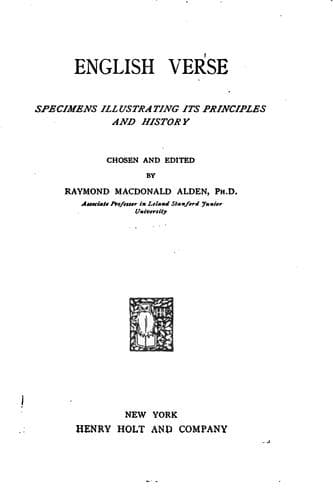
English Verse: Specimens Illustrating its Principles and HistoryAlden, Raymond MacDonald
General
English Verse: Specimens Illustrating its Principles and History
Alden, Raymond MacDonald
English language -- Versification; English poetry
Still another kind of relative syllable-length remains to be considered,
and for metrical purposes it is probably the most important. The
_accents_ of English words not only vary in degree according to the
different stresses which they receive in different prose sentences, but
in verse they are made artificially to vary also so as to conform as
closely as possible to the scheme of the metre. Thus the first syllable
of the word _over_ is accented far more strongly when it occurs at the
opening of a dactylic verse,
"Over the ocean wave,"
than when it occurs at the opening of an anapestic verse,
"Over land, over sea."
This being the case with accent, which tends to be strongly fixed in
English words, we might naturally expect that it would be still more
clearly the case with the element of time; and so it is. Syllables will
be lengthened and shortened by the reader in order to preserve as nearly
as possible the fundamental equal time-intervals between the principal
accents. This is most easily recognized, and most commonly practised, in
the case where syllables are shortened because there are more of them
than the normal scheme of the verse would imply. The old "tumbling
verse" of our ancestors depended on this principle, and so did the
revival of it in Coleridge's _Christabel_. For example:
"A little door she opened straight,
All in the middle of the gate,
The gate that was ironed within and without,
Where an army in battle array had marched out."
Here the rhythm of the last verse is brought into the four-beat measure
of the first verse, by passing lightly and rapidly over all syllables
save the four that mark the metre. In prose, the word _marched_ would be
stressed quite as much as the word _out_, but there is no difficulty in
reducing the stress in reading the verse.[54] It cannot be said,
however, that there is no difficulty in reducing its _length_, for the
final consonant combination _-cht_ takes up considerable time, and the
whole word follows a syllable (_had_) which has been closed and so
lengthened by the _d + m_. Sensitive readers would probably agree,
therefore, that the quantity in this verse is too much for the
smoothness of the rhythm. On the other hand, the long syllable _ironed_
helps us to fill the place of the light syllable which is missing after
it, and we find the rhythm easier than it would be in this form:
"The gate that was ironed both within and without."
Once more, for the sake of convenience, let us attempt to put our
conclusions into the form of a summary. An English syllable may be said
to be _long_, not absolutely but _relatively_, from:
[1. The naturally long character of its vowel-sound, due either
to open quality or diphthongization.]
2. The presence of two or more consonants which require a
perceptible time for utterance.
Public-domain text, read in full here on John Shaqi.
Reviews
Reviews
No reviews yet
Be the first to share your thoughts on this work.
Elsewhere in the archive
Join the Discussion
Join the discussion
Sign in to leave a comment or review.
Sign InorCreate an account