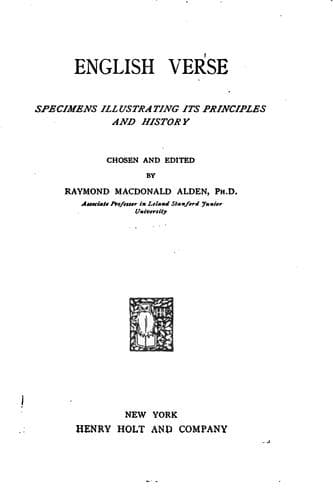
English Verse: Specimens Illustrating its Principles and HistoryAlden, Raymond MacDonald
General
English Verse: Specimens Illustrating its Principles and History
Alden, Raymond MacDonald
English language -- Versification; English poetry
[53] See Mr. Larminie's article on "The Development of English Metres"
in the _Contemporary Review_ for November, 1894. In this article there
is one of the clearest statements of the place of quantity in our verse
that one can easily find. Mr. Larminie seems disposed, however, to place
too much stress on the element of fixed or natural quantity, and
sometimes to use the terms "long" and "short" with merely traditional
meanings. The most characteristic feature of his discussion is, that he
establishes certain principles of quantity, and judges the poets by
their conformity to these principles. The inductive method is less
pretentious and perhaps safer: to inquire what the poets do, and how in
the reading of their verse we may preserve the rhythm which they
undoubtedly had in mind. Both methods are legitimate. One will lay down
rules for the poet, another for the reader; and there is perhaps as much
chance of one being followed as of the other.
[54] At least no difficulty has generally been found; but Mr. Liddell
marks the word as one which _must_ be stressed from its grammatical
importance. He even finds Coleridge untrue to the metre in putting
_where_ in an unstressed place in the verse, on the ground that it means
"through which." It would perhaps be safe to guess that no
unsophisticated English reader has ever found difficulty in the accents
of the line in question. The matter is worthy of remark as illustrating
the tendency of one class of readers to emphasize _sense_-reading at the
expense of rhythm. On the other hand, for an illustration of the
opposite extreme see Professor Bright's article on "Grammatical Ictus in
English Verse," in the Furnivall _Miscellany_ (1901), where we are told,
in effect, that the metrical accent must always triumph over the
sense-accent. As usual, the truth seems to lie somewhere between the
extremes.
[55] This seems to be a part of the old effort to seek a grammatical
rather than a musical origin for metre. On this subject the reader
should see the brilliant discussion of Professor Gummere in _The
Beginnings of Poetry_, from which a few paragraphs are quoted in Part
Four.
PART FOUR
THE PLACE AND FUNCTION OF THE METRICAL ELEMENT IN POETRY
The following extracts from important critical discussions are
selected with reference to their bearing on two questions: Is metre
an essential or only an incidental element of poetry? and, What are
its functions in the total content and effect of poetry? The
student of the subject will do well to analyze the answers to the
second question, determining under how many aspects of the metrical
element they can be grouped.
Public-domain text, read in full here on John Shaqi.
Reviews
Reviews
No reviews yet
Be the first to share your thoughts on this work.
Elsewhere in the archive
Join the Discussion
Join the discussion
Sign in to leave a comment or review.
Sign InorCreate an account