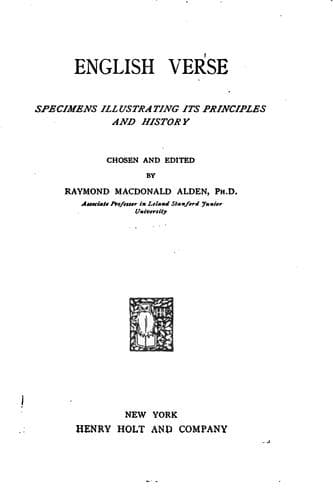
English Verse: Specimens Illustrating its Principles and HistoryAlden, Raymond MacDonald
General
English Verse: Specimens Illustrating its Principles and History
Alden, Raymond MacDonald
English language -- Versification; English poetry
Poetry in general seems to have sprung from two causes, each of them
lying deep in our nature. First, the instinct of imitation is implanted
in man from childhood.... Next, there is the instinct for harmony and
rhythm, metres being manifestly sections of rhythm. Persons, therefore,
starting with this natural gift developed by degrees their special
aptitudes, till their rude improvisations gave birth to Poetry.
(ARISTOTLE: _Poetics_, iv. Butcher's translation, pp. 15, 17.)
Poetry, music, and dancing constitute in Aristotle a group by
themselves, their common element being imitation by means of
rhythm--rhythm which admits of being applied to words, sounds, and the
movements of the body. The history of these arts bears out the views we
find expressed in Greek writers upon the theory of music; it is a
witness to the primitive unity of music and poetry, and to the close
alliance of the two with dancing.... The intimate fusion of the three
arts afterward known as the "musical" arts--or rather we should perhaps
say, the alliance of music and dancing under the supremacy of
poetry--was exhibited even in the person of the artist. The office of
the poet as teacher of the chorus demanded a practical knowledge of all
that passed under the term "dancing," including steps, gestures,
attitudes, and the varied resources of rhythmical movement.... The poet,
lyric or dramatic, composed the accompaniment as well as wrote the
verses; and it was made a reproach against Euripides, who was the first
to deviate from the established usage, that he sought the aid of Iophon,
son of Sophocles, in the musical setting of his dramas. The very word
"poet" in classical times often implies the twofold character of poet
and musician, and in later writers is sometimes used, like our
"composer," in a strictly limited reference to music.
Aristotle does full justice to the force of rhythmic form and movement
in the arts of music and dancing. The instinctive love of melody and
rhythm is, again, one of the two causes to which he traces the origin of
poetry, but he lays little stress on this element in estimating the
finished products of the poetic art. In the _Rhetoric_ he observes that
if a sentence has metre it will be poetry; but this is said in a popular
way. It was doubtless the received opinion, but it is one which he twice
combats in the _Poetics_, insisting that it is not metrical form that
makes a poem....
Public-domain text, read in full here on John Shaqi.
Reviews
Reviews
No reviews yet
Be the first to share your thoughts on this work.
Elsewhere in the archive
Join the Discussion
Join the discussion
Sign in to leave a comment or review.
Sign InorCreate an account