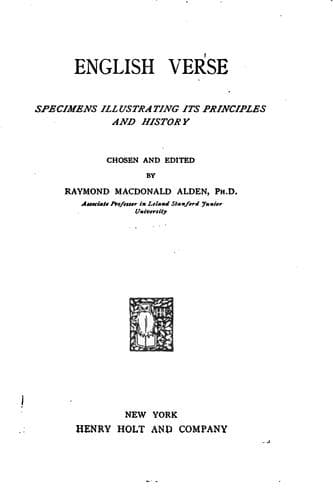
English Verse: Specimens Illustrating its Principles and HistoryAlden, Raymond MacDonald
General
English Verse: Specimens Illustrating its Principles and History
Alden, Raymond MacDonald
English language -- Versification; English poetry
ideas conveyed, not in the blending of soul and sense, but in the sound
itself, in the cadence of the verse. Yet, false as this view may be, it
is not perhaps more false than that other which wholly ignores the
effect of musical sound and looks only to the thought that is conveyed.
Aristotle comes perilously near this doctrine.
(S. H. BUTCHER: _Aristotle's Theory of Poetry and Fine Art_. pp.
138-147.)
It is not riming and versing that maketh a poet, no more than a long
gown maketh an advocate; who, though he pleaded in armor, should be an
advocate and no soldier. But it is that feigning notable images of
virtues, vices, or what else, with that delightful teaching which must
be the right describing note to know a poet by; although, indeed, the
senate of poets hath chosen verse as their fittest raiment, meaning, as
in matter they passed all in all, so in manner to go beyond them: not
speaking (table-talk fashion, or like men in a dream) words as they
chanceably fell from the mouth, but poyzing each syllable of each word
by just proportion according to the dignity of the subject....
It is already said (and as I think, truly said) it is not riming and
versing that maketh poesy.... But yet, presuppose it were inseparable
(as, indeed, it seemeth Scaliger judgeth) truly it were an inseparable
commendation. For if _oratio_ next to _ratio_, speech next to reason, be
the greatest gift bestowed upon mortality, that cannot be praiseless,
which doth most polish that blessing of speech, which considers each
word, not only (as a man may say) by his forcible quality, but by his
measured quantity, carrying even in themselves a harmony, without
(perchance) number, measure, order, proportion, be in our time grown
odious. But lay aside the just praise it hath, by being the only fit
speech for music (music, I say, the most divine striker of the senses);
thus much is undoubtedly true, that if reading be foolish, without
remembering, memory being the only treasurer of knowledge, those words
which are fittest for memory are likewise most convenient for knowledge.
Now, that verse far exceedeth prose in the knitting up of the memory,
the reason is manifest. The words (besides their delight, which hath a
great affinity to memory), being so set, as one word cannot be lost, but
the whole work fails, which accuseth itself, calleth the remembrance
back to itself, and so most strongly confirmeth it. Besides, one word
so as it were begetting another, as be it in rime or measured verse, by
the former a man shall have a near guess to the follower.... So that,
verse being in itself sweet and orderly, and being best for memory, the
only handle of knowledge, it must be in jest that any man can speak
against it.
(SIR PHILIP SIDNEY: _An Apologie for Poetrie_.)
Public-domain text, read in full here on John Shaqi.
Reviews
Reviews
No reviews yet
Be the first to share your thoughts on this work.
Elsewhere in the archive
Join the Discussion
Join the discussion
Sign in to leave a comment or review.
Sign InorCreate an account