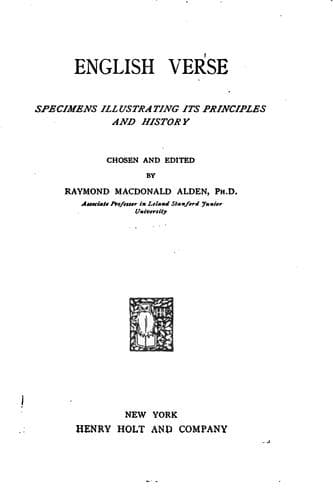
English Verse: Specimens Illustrating its Principles and HistoryAlden, Raymond MacDonald
General
English Verse: Specimens Illustrating its Principles and History
Alden, Raymond MacDonald
English language -- Versification; English poetry
Versification, or the art of modulating his numbers, is indispensably
necessary to a poet. Every other power by which the understanding is
enlightened, or the imagination enchanted, may be exercised in prose.
But the poet has this peculiar superiority, that to all the powers which
the perfection of every other composition can require, he adds the
faculty of joining music with reason, and of acting at once upon the
senses and the passions. I suppose there are few who do not feel
themselves touched by poetical melody, and who will not confess that
they are more or less moved by the same thoughts, as they are conveyed
by different sounds, and more affected by the same words in one order
than another. The perception of harmony is, indeed, conferred upon men
in degrees very unequal; but there are none who do not perceive it, or
to whom a regular series of proportionate sounds cannot give delight.
(SAMUEL JOHNSON: _The Rambler_, No. 86.)
Various causes might be pointed out why, when the style is manly, and
the subject of some importance, words metrically arranged will long
continue to impart such a pleasure to mankind as he who proves the
extent of that pleasure will be desirous to impart. The end of poetry is
to produce excitement in coexistence with an overbalance of pleasure;
but, by the supposition, excitement is an unusual and irregular state of
the mind; ideas and feelings do not, in that state, succeed each other
in accustomed order.... Now the co-presence of something regular,
something to which the mind has been accustomed in various moods and in
a less excited state, cannot but have great efficacy in tempering and
restraining the passion by an intertexture of ordinary feeling, and of
feeling not strictly and necessarily connected with the passion. This is
unquestionably true; and hence, though the opinion will at first appear
paradoxical, from the tendency of metre to divest language, in a certain
degree, of its reality, and thus to throw a sort of half-consciousness
of unsubstantial existence over the whole composition, there can be
little doubt but that more pathetic situations and sentiments--that is,
those which have a greater proportion of pain connected with them--may
be endured in metrical composition, especially in rime, than in
prose.... This opinion may be further illustrated by appealing to the
reader's own experience of the reluctance with which he comes to the
reperusal of the distressful parts of _Clarissa Harlowe_, or the
_Gamester_; while Shakspere's writings, in the most pathetic scenes,
never act upon us as pathetic beyond the bounds of pleasure--an effect
which, in a much greater degree than might at first be imagined, is to
be ascribed to small, but continual and regular impulses of pleasurable
surprise from the metrical arrangement.[56] On the other hand (what it
must be allowed will much more frequently happen), if the poet's words
should be incommensurate with the passion, and inadequate to raise the
Public-domain text, read in full here on John Shaqi.
Reviews
Reviews
No reviews yet
Be the first to share your thoughts on this work.
Elsewhere in the archive
Join the Discussion
Join the discussion
Sign in to leave a comment or review.
Sign InorCreate an account