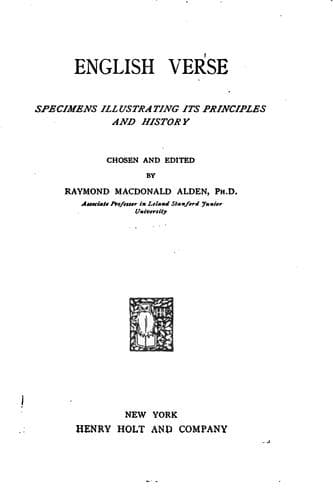
English Verse: Specimens Illustrating its Principles and HistoryAlden, Raymond MacDonald
General
English Verse: Specimens Illustrating its Principles and History
Alden, Raymond MacDonald
English language -- Versification; English poetry
... In considering the total contribution of metre to imaginative
language, it is impossible to overlook the quality of _permanence_. I do
not mean permanence merely in the sense that metrical words live in the
memory.... This is, of course, a most important fact; but I am here
dealing only with elements of effect that enter into the actual moment
of enjoyment.... It is a sense of combined parts, and their
indispensableness one to another, which gives us a sense of permanence
in an arch as compared with a casual heap of stones; it is a similar
indispensableness which gives to metrical language an air of permanence
impossible even to the most harmonious sentence whose sounds conform to
no genuine scheme. And again, in the case of this constituent as of the
others, we have no difficulty in seeing that its influence is really a
joint one of sound and sense--that, though founded in the nature of
metrical sound as such, it is not merely a sound-quality superposed _ab
extra_ on the intelligible beauty of the words, but depends for its
existence on their intelligible character.... We cannot glory in the
enshrining for memory of things that we do not care to remember. But for
that which is of true spiritual significance the fairly-fitted body of
sound is greeted as the inevitable investiture; and thus justified and
quickened, the strength of the mutually indispensable parts seems no
longer that of mere structure but of organic life.
(EDMUND GURNEY: Essay on "Poets, Critics, and Class-Lists," in _Tertium
Quid_, vol. ii. pp. 162-179, _passim_.)
Why have poets always written in metre? The answer is, Because the laws
of artistic expression oblige them to do so. When the poet has been
inspired from without in the way in which we saw Scott was inspired to
conceive the _Lay of the Last Minstrel_--that is to say, when he has
found his subject-matter in an idea, universally striking to the
imagination, when he has received this into his own imagination, and has
given it a new and beautiful form of life there, then he will seek to
express his conception through a vehicle of language harmonizing with
his own feelings and the nature of the subject, and this kind of
language is called verse. For example, when Marlowe wishes to represent
the emotions of Faustus, after he has called up the phantom of Helen of
Troy, it is plain that some very rapturous form of expression is needed
to convey an adequate idea of such famous beauty. Marlowe rises to the
occasion in those "mighty lines" of his:
"Was this the face that launched a thousand ships,
And burned the topless towers of Ilium?"
But it is certain that he could only have ventured on the sublime
audacity of saying that a face launched ships and burned towers by
escaping from the limits of ordinary language, and conveying his
metaphor through the harmonious and ecstatic movements of rhythm and
metre....
Public-domain text, read in full here on John Shaqi.
Reviews
Reviews
No reviews yet
Be the first to share your thoughts on this work.
Elsewhere in the archive
Join the Discussion
Join the discussion
Sign in to leave a comment or review.
Sign InorCreate an account