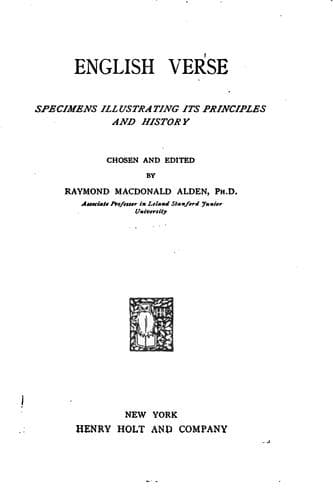
English Verse: Specimens Illustrating its Principles and HistoryAlden, Raymond MacDonald
General
English Verse: Specimens Illustrating its Principles and History
Alden, Raymond MacDonald
English language -- Versification; English poetry
Nor is this all. Rhythm perpetually not only transfigures the poetical
expression of an idea, but makes the existence of that expression
possible. This is tolerably obvious in the case of what is often called
_par excellence_ poetical language--language which keeps clear of
prosaic homeliness and prosaic precision and of technical and abstract
terms, and confines itself to a more picturesque and loftier
vocabulary.... Clearly it is the rarity of rhythmic, as compared with
non-rhythmic, speech that supports such rarity of poetic as compared
with non-poetic diction; that is to say, verse, being in one
respect--namely, its effect on the ear--a marked exception from ordinary
language, thereby establishes for itself the means of being exceptional,
without seeming unnatural, in other ways....
... In dwelling on the non-reasonable part in poetical beauty, I am in
no way committed to the assertion that all its constituents are excluded
from prose, but only to the assertion that the metrical form makes a
difference of kind. It cannot be for nothing that the very idea of
"poetical prose" inspires dread; and the instances of prose-writing
where we find delight of the intangible and non-reasonable kind are
exceptions that only prove the rule. One has but to test by
self-examination the living force of words in a specimen of verse and of
poetical prose which may respectively seem to oneself first-rate of
their kind. For such typical passages may often be regarded as fairly on
a par in respect of the ideas and emotions which they reasonably
express; and the prose may unquestionably further resemble the poetry in
a certain subtle individuality of life in its more prominent words, so
far as this life can be quickened in them by the idea itself, aided by
such qualities of sound-arrangement as are possible apart from metre. So
far the poetical merits of the respective passages may be equal; yet
only one of them is Poetry.... Language, which in prose does little more
than transmit thought, like clear glass, becomes--even as that
becomes--by art's adjustments and the moulding of measured form, a lens,
where the thought takes fire as it passes. The poet speaks through a
medium which seems to intensify the point and to extend the range of
what he would tell us by some power outside his own volition. Such a
power, in fact, a rhythmic order, in its fundamental appeal to human
nerves, literally is.... The _ictus_ of the verse comes upon us as the
operative force which shocks the words into their unwonted life.
Public-domain text, read in full here on John Shaqi.
Reviews
Reviews
No reviews yet
Be the first to share your thoughts on this work.
Elsewhere in the archive
Join the Discussion
Join the discussion
Sign in to leave a comment or review.
Sign InorCreate an account