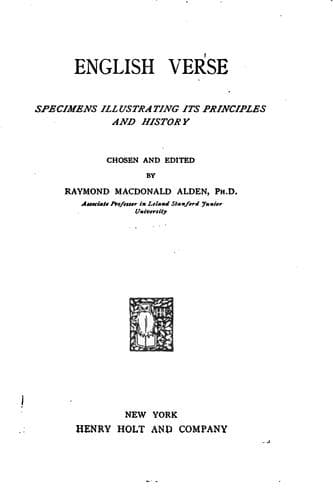
English Verse: Specimens Illustrating its Principles and HistoryAlden, Raymond MacDonald
General
English Verse: Specimens Illustrating its Principles and History
Alden, Raymond MacDonald
English language -- Versification; English poetry
For analysis of this revived alliterative verse, see a valuable
article by Dr. Luick, _Die Englische Stabreimzeile im 14n, 15n, und
16n Jahrhundert_, in _Anglia_, vol. xi. pp. 392 and 553. Luick
analyzes not only the poems of the "Pearl poet," but also the _Troy
Book_, the _Alexander Fragments_, _William of Palerne_, _Joseph of
Arimathea_, _Morte Arthure_, and minor poems. He finds the _Troy
Book_ the most regular alliterative poem of Middle English, but in
all of the group a general tendency to preserve not only the early
laws of alliteration but also the "five types" of Sievers's
Anglo-Saxon metrics. Dr. Luick attributes the final decline of the
old measure in large degree to the falling away of the final
syllables in _-e_, etc.; without these numerous feminine endings
the primitive "long line" was impossible. This he regards as
regrettable, since the old alliterative verse, "growing up on
native soil with the language itself," represented the natural
accent-relations of the Germanic languages, especially the
recognition of two principal degrees of accent; whereas the modern
rimed verse requires the reduction of this to a uniform "tick-tack"
of alternating stress and non-stress.
He put on his back a good plate-jack,
And on his head a cap of steel,
With sword and buckler by his side;
O gin he did not become them weel!
(_Ballad of Bewick and Grahame_. In GUMMERE'S _English Ballads_, p.
176.)
The regular stanza of the old ballads was of this four-stress type, with
extra light syllables admitted anywhere yet not in great numbers. More
commonly, however, the fourth stress was lost from the second and fourth
lines. (See p. 264, below.)
I thanke hym full thraly, and sir, I saie hym the same,
But what marvelous materes dyd this myron ther mell?
For all the lordis langage his lipps, sir, wer lame,
For any spirringes in that space no speche walde he spell.
(_York Mystery Plays: The Trial before Pilate_. Ed. L. T. SMITH, p.
322.)
As Gammer Gurton, with manye a wyde styche,
Sat pesynge and patching of Hodg her mans briche,
By chance or misfortune, as shee her geare tost,
In Hodge lether bryches her needle shee lost.
(_Gammer Gurton's Needle_, Prologue. 1566.)
In these specimens we have the later descendant of the long line as used
in the early drama of the fifteenth and sixteenth centuries,--the
"tumbling verse," regular in rhythm and rime, but indifferent to the
number of syllables.[17] Sometimes, where most regular, as in lines 2-4
of the second specimen, the measure approximates closely to regular
four-stress anapestic.
Public-domain text, read in full here on John Shaqi.
Reviews
Reviews
No reviews yet
Be the first to share your thoughts on this work.
Elsewhere in the archive
Join the Discussion
Join the discussion
Sign in to leave a comment or review.
Sign InorCreate an account