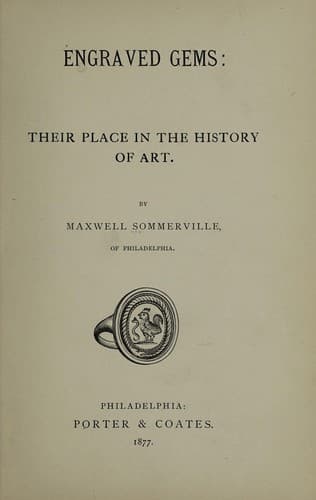
Presuming that the majority of my readers would understand the Latin
inscription from an engraved stone, which decorates the cover of this
book, I have not given any translation. By request I add the following
explanation:
NON SOLVM NO|BIS NATI SVMVS|ORTVSQVE NOSTRI|PARTEM
PATRIA SI|BI VENDICAT PARTEM|PARENTES PARTEM AMICI|
“Not alone for ourselves were we born, and of our
birth our country claims for itself a part, our parents
a part, our friends a part” (vendicat for vindicat).
On the reverse of the stone, which is not shown, is the inscription--
MORTIS MORES OMNIBUS ÆQUALES.
This is one of those peculiar maxims so often found in the Latin
language, as it is employed in epitaphs. The simplest manner in which
it can be translated is as follows:
{manners}
{customs} {are}
“The {usage } of Death {is } equal for all.”
{law }
Death is here personified, as was Peace, Justice, Concord, etc., by the
Romans.
MAXWELL SOMMERVILLE.
CONTENTS.
PAGE
ENGRAVED GEMS 11
EGYPT 16
PERSIA AND BABYLON 22
THE ETRUSCANS--ETRURIA 36
PHŒNICIA 43
GREECE 48
ROMAN 55
ABRAXAS 58
EARLY CHRISTIANS 65
BYZANTINE 68
MEDIÆVAL 76
RENAISSANCE 80
SUCCEEDING DECLINES AND REVIVALS 86
SOME TYPES OF REMARKABLE GEMS 89
RELIGION ON STONES 98
HISTORIC CAMEOS 104
ANIMALS AND BIRDS 112
ANTIQUE PASTES 116
MYTHOLOGICAL 121
CHINESE, BURMESE, AND SIAMESE 123
AZTEC OR MEXICAN 127
RETROSPECTIVE 129
LIST OF ILLUSTRATIONS.
PAGE
Protogenis, a Comedian of the Second Century, with a Mask,
Playing the Character of Meleager, the “Wild Boar Hunter,”
Engraved in His Time 11
Vestal Virgins Guarding the Palladium, the Sacred Effigy of Minerva 15
Public-domain text, read in full here on John Shaqi.
Reviews
Reviews
No reviews yet
Be the first to share your thoughts on this work.
Join the Discussion
Join the discussion
Sign in to leave a comment or review.
Sign InorCreate an account