Almost until now no plea has been offered for glyptology as a factor
contributing historical data. The mass of scientists have been
contented with musty old volumes, and these little message-bearing
stones have been regarded as nothing more than curious ancient articles
of luxury, yet you will remark we do not look on them in that light; we
recognize, as we justly should, each and every piece as part of a great
story, recording and illustrating many epochs and eras in this world’s
history, and patiently we have been seeking to replace each fragment
into its proper place in the inscribed diagram, until we are convinced
that we read thereon many things that no manuscripts or books have
communicated to us.
SOME TYPES OF REMARKABLE GEMS.
My entire collection in the Free Museum of Science and Art of the
University of Pennsylvania must be examined to see types of all these
epochs. It may be well to notice here three or four very remarkable
gems of which monographs have also been published.
BACCHUS AND ARIADNE.
Ariadne is seated on the rocks of Dia, where Bacchus found her; at her
feet is her panther. Bacchus bears in his hand a thrysus; his javelin
with its point in the form of a pine cone; his head wreathed with ivy
and grape leaves; his hand lovingly placed on sad Ariadne’s shoulder,
who has just been deserted by Theseus. Bacchus, deeply in love (which
is indicated by the figure of Cupid), says to her, “I shall care
for thee.” The panther at the feet of Ariadne is emblematic of the
principal and most important incident in her life, her love for Theseus.
Ariadne was the daughter of Minos, King of Crete. She fell in love with
Theseus when he went as one of the seven youths whom the Athenians were
obliged to send every year with seven maidens to Crete to be devoured
by the Minotaur.
Ariadne provided Theseus with a sword with which he slew the Minotaur,
and with a thread which enabled him to find his way out of the
labyrinth; they then fled to the island of Naxos (Dia), where Theseus,
warned by a god in a dream, deserted her. Bacchus arrived opportunely
from India, finding Ariadne in a state of grief and consternation,
which even added to her charming beauty; he quenched her tears,
consoled her, and took her to himself. This exquisite gem is a fine
representation of Renaissance work (see plate on p. 81).
JUPITER ÆGIOCHUS.
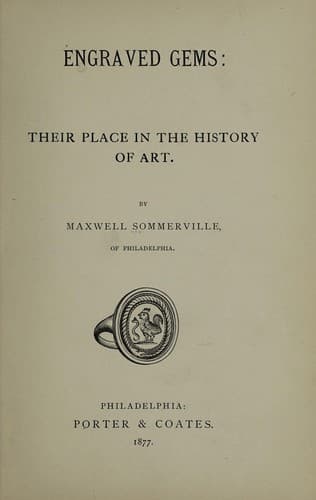
Among examples of antique glyptic art, by referring to my late work on
“Engraved Gems: Their Place in the History of Art,” you will find an
extended notice of the superb ancient cameo on chrysoprase of Jupiter
Ægiochus. It is the eighth of importance in the remarkable antique
cameos that have been preserved from the early centuries after Christ.
It is of remarkable dimensions, being 167 millimetres in height by 130
millimetres in breadth.
Public-domain text, read in full here on John Shaqi.
Reviews
Reviews
No reviews yet
Be the first to share your thoughts on this work.
Join the Discussion
Join the discussion
Sign in to leave a comment or review.
Sign InorCreate an account