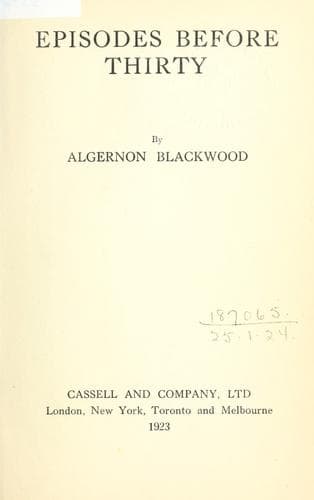
Authors, English -- 20th century -- Biography; Blackwood, Algernon, 1869-1951
With the memory of the past, similarly, such folk show wisdom.
Reincarnation is an interesting theory to many; yet to recall past
lives could have but one effect--to render one ineffective now. To
recall the failures of a mere forty years is bad enough; to look back
over a hundred lives would be disastrous: one could only sit down and
cry.
December had come with its cold and bitter winds, and the doctor, ever
faithful, had let me up. I went for my first little walk, leaning
on Boyde’s arm. Round Gramercy Park we crawled slowly, and that
first taste of fresh air, the sound of wind in the leafless trees,
a faint hint of the sea that reaches even the city streets, gave me
an unforgettable happiness and yearning. The plan to settle in the
backwoods again obsessed me. A little later I had almost persuaded
the doctor, and Kay in my letters, to take up a claim north of the
Muskoka Lakes where we had spent such a happy summer. Boyde was to come
too--“as a sort of excitement, I suppose!” was the doctor’s bitter
comment.
I grew gradually stronger. Reporting was still impossible, but,
introduced by Boyde, I earned something by posing in the studios. A
“sitting” was three hours. Some artists paid by the hour, but Charles
Dana Gibson, then drawing his weekly cartoons in _Life_, always paid
for a full sitting, though he might use his model for an hour only.
He was a rapid worker, and a good fellow; he never forgot to ask
if one was tired of any particular attitude; my first pose to him
was for a broken-down actor leaning against a hoarding covered with
advertisements, the joke being something about a bill-board and a
board-bill. I was thrilled when it appeared in _Life_. There was always
a great rush among the models for Gibson’s studio. The only other poses
I remember are swinging a golf club and sitting for a bishop’s arms and
hands. I wore big sleeves. These, however, were not in Gibson’s studio.
My memory of this work is dim; it was not unpleasant; only its
uncertainty against it, though a good week might bring in as much as
fifteen dollars. Smedley, who illustrated for _Harper’s Magazine_, was
the painter we all disliked most; Cox, son of Bishop Cox, Cleveland
Cox being his full name, I think, was a favourite: he was a gentleman.
There was Zogbaum too, another illustrator, and there was Lynwood
Palmer, the horse-painter, and leading artist on _The Rider and
Driver_, a first-class weekly of that day. “Artist Palmer,” as the
papers called him later, was a character. His kindness to me stands
out. He had very great talent--for getting the likeness of a horse.
We called him “The Horse.” He made a success at his work, painted
the “King’s Horses and Men” in subsequent years, and settled down
eventually--he was an Englishman--I believe, at Heston, Hounslow. His
New York studio was in Fifth Avenue. Many a time he gave me food there.
Public-domain text, read in full here on John Shaqi.
Reviews
Reviews
No reviews yet
Be the first to share your thoughts on this work.
Elsewhere in the archive
Join the Discussion
Join the discussion
Sign in to leave a comment or review.
Sign InorCreate an account