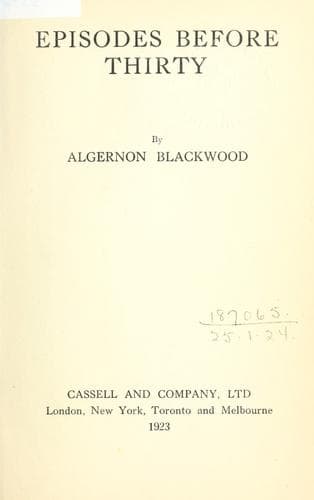
Authors, English -- 20th century -- Biography; Blackwood, Algernon, 1869-1951
The establishment, the poverty, the alternating moods, as I said,
puzzled me; I was aware of a whole life hidden away from my
observation. They were so poor that dinner was the meal of a workman,
they could not even keep a servant. There were worrying debts as well.
Often the doctor was so bearish and irritable that I dared not say a
word, his wife got curses and abuse, he would almost kick the child,
finding fault with such sneers and rudeness that I vowed to myself I
would never eat his food again. Then, after a momentary absence in his
workshop upstairs, where he kept a lathe and made beautiful chessmen,
he would come slowly stumbling down again, and the door would open to a
wholly different being. Bent, as always, but well poised and vigorous,
with bright smiling eyes, benevolent yet rugged face, every gesture
full of gentle kindness, he would pat his old wife on the shoulder and
take the child upon his knee, and beg me to play the fiddle to him or
to draw my chair up for an intimate talk. He would light his great
meerschaum pipe and beam upon the world through the blue smoke like
some old jolly idol. The change seemed miraculous.
His talk seemed, at the time, wonderful to me. He would discourse
on Kant, Novalis, Heine, on music, science, astronomy--“when your
troubles seem at their worst,” he would say, “look up at the stars
for half an hour, _with imagination_, and you’ll see your troubles
in a new perspective”--on religion, literature and life, on anything
and everything, while downstairs his kindly old wife prepared the
Frankfurters and sauerkraut and coffee.
Neither mother nor child, I noticed, paid much attention to his
attacks. The little girl, who called her father “Otto,” sat up with
us night after night till two in the morning, and hated going to bed.
She listened spellbound to the stream of talk. I still see the dingy,
lamp-lit room in the heart of the roaring city, the white-haired old
doctor, pipe in mouth, the operating chair in the middle of the floor,
the little pale-faced child with her odd expression of maturity as she
looked from him to me, then led me by the hand to our late meal in the
gloomy basement. I often waited achingly for that meal, having eaten
nothing since breakfast. Would he never stop talking...?
We talked of Boyde--his face. The doctor’s reading of Boyde’s face was
that it was a bad, deceitful, clever face, evil, brutal and cruel. I
mentioned the man’s various acts of kindness. “Bait,” he exclaimed,
with a scornful snort, “mere bait! He wanted a free lodging. He had
plenty of money all along, but the free bed gave him more--to spend on
himself while you starved.”
Public-domain text, read in full here on John Shaqi.
Reviews
Reviews
No reviews yet
Be the first to share your thoughts on this work.
Elsewhere in the archive
Join the Discussion
Join the discussion
Sign in to leave a comment or review.
Sign InorCreate an account