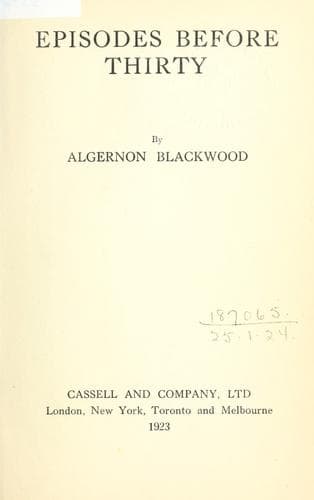
Authors, English -- 20th century -- Biography; Blackwood, Algernon, 1869-1951
He talked on about faces.... Handsome ones he either disliked or
distrusted, handsome features like Boyde’s were too often a cloak that
helped to hide and deceive. Behind such faces, as a rule, lay either
badness or vacuity; good looks were the most misleading thing in the
world. Expression rarely accompanied good looks, good features. He was
off on a pet hobby, he waxed eloquent. Beautiful women--he spoke of
good features chiefly--were almost invariably wicked, or else empty. Of
“Society Beauties” he was particularly contemptuous. “Regular features,
fine eyes, perfect skin, but no expression--no soul within. The
deer-like eyes, the calm, proud loveliness people rave about is mere
vacancy. Pfui!”
His habit of staring into the mirror came back to me, and I ventured a
question. He hesitated a moment, then got up and led me to the glass,
where, without a word, he began to gaze at his own reflection, making
the familiar grimaces, smiling, screwing up his eyes, stretching his
lips, raising his eyebrows, pulling his moustache about until, at last,
I burst into laughter I could control no longer.
He turned in astonishment. He examined my own face closely for some
time. “You are too young still,” he said. “You have no lines. In my
face, you see, lies all my past, layer below layer, skin behind skin,
my face of middle age, of early manhood, of youth, of childhood. It
carries me right back.”
He began showing me again, pointing to his reflection as he did so.
“That’s middle age ... that’s youth.... Ach! and there’s the boy’s
face, look!”
I did not dare to look, for explosions of laughter were in my throat,
and I should have hurt his feelings dreadfully. I understood what he
meant, however.
“With the face of each period,” he explained, “rise the memories,
feelings and emotions of that particular period, its point of view, its
fears, ambitions--_hopes_. I live again momentarily in it. I am a young
man again, a boy, a child. I am, at any rate, no longer myself--_as
I now am_.” The way he spoke these four words was very grave and
sad. “Now,” he went on with a sigh, “you understand the charm of the
mirror. It means escape from self. This is the ultimate teaching of
all religion--to escape from Self.” He chuckled. “The mirror is my
Religion.”
Public-domain text, read in full here on John Shaqi.
Reviews
Reviews
No reviews yet
Be the first to share your thoughts on this work.
Elsewhere in the archive
Join the Discussion
Join the discussion
Sign in to leave a comment or review.
Sign InorCreate an account