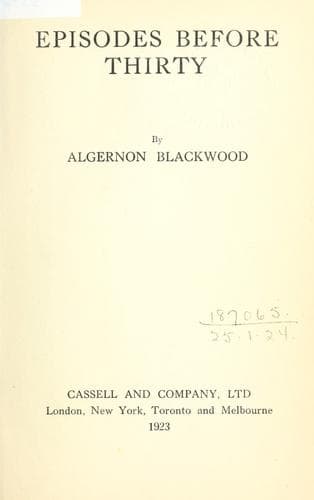
Authors, English -- 20th century -- Biography; Blackwood, Algernon, 1869-1951
During this odd little scene I felt closer to his secret than ever
before. There was something fine and lovely in him, something big,
but it lay in ruins. Had my attitude been a little different, had I
not laughed for instance, I think he would have taken me into his
confidence there and then. But the opportunity was lost this time.
He asked, instead, for music, old, simple German songs being what he
liked most. He would lean back in his big chair, puff his great pipe,
close his eyes, and hum the melodies softly to himself while I played.
It was easy to vamp a sort of accompaniment with double stopping.
He dreamed of old days, I suppose; it was a variant of the mirror
game. Tschaikowsky, Meyer-Helmund, Massenet he also liked, but it was
Schubert, Schumann, even Mendelssohn he always hummed to. Of “_Ich
grolle-nicht, auch wenn das Herz mir bricht_,” he never tired. The
little child would dart up from the basement at the first sound of the
fiddle, show her old, white face at the door, then creep in, sit in a
corner, and never take her eyes from “the orchestra.” When it stopped
playing, she was off again in a second.
One item, while speaking of the music, stands out--chanting to the
fiddle a certain passage from De Quincey. The “Confessions” fascinated
him; the description of the privations in London, the scenes with
Anne when she first brought him out of her scanty money the reviving
glass of port, her abrupt disappearance finally and his pathetic
faithful search, the lonely hours in the empty house in Greek Street,
but particularly his prolonged fight against the drug. It was the
Invocation to Opium, a passage of haunting beauty, however, he loved
so much that he chanted it over and over to himself. The first time he
did this I invented a soft running accompaniment on the lower strings,
using double stopping. The mute was on. My voice added the bass. It
was a curious composition of which he never tired; it moved him very
deeply; I have even seen tears trickling down his cheeks when it was
over. He always left his chair for this performance, walking slowly to
and fro while he chanted the rhythmical, sonorous sentences:
“O just, subtle and mighty opium! that, to the hearts of rich and
poor alike, for the wounds that will never heal, and for the pangs
of grief that tempt the spirit to rebel, bringest an assuaging
balm;--eloquent opium! that with thy potent rhetoric stealest away
the purposes of wrath.... Thou buildest upon the bosom of darkness,
out of the fantastic imagery of the brain, cities and temples,
beyond the art of Phidias and Praxiteles, beyond the splendours
of Babylon and Hekatompylos; ... and hast the keys of Paradise, O
just, subtle and mighty opium...!”
Public-domain text, read in full here on John Shaqi.
Reviews
Reviews
No reviews yet
Be the first to share your thoughts on this work.
Elsewhere in the archive
Join the Discussion
Join the discussion
Sign in to leave a comment or review.
Sign InorCreate an account